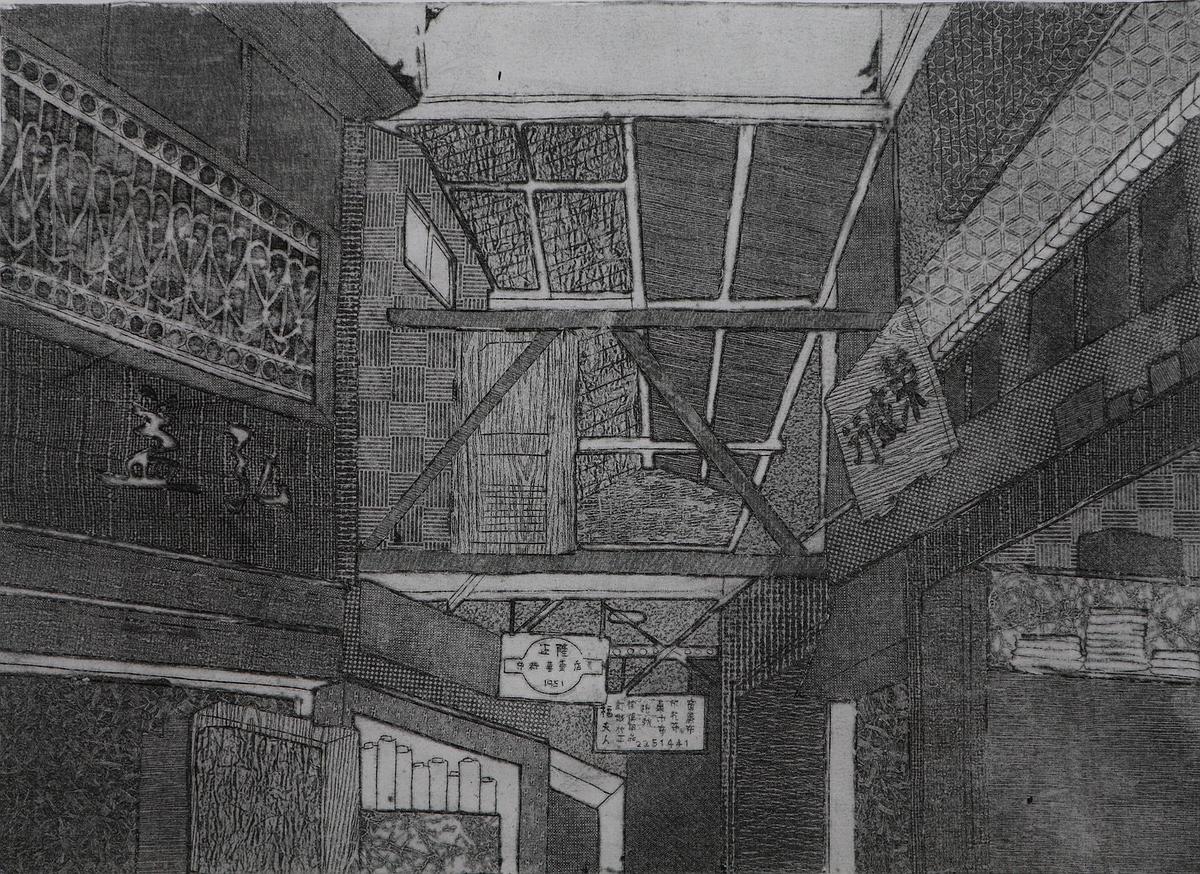
The study aims to recreate present and past landscape, to extract the imagination and emotion left in the mind, and to display it in prints. The work slowly forms a perspective in the architectural scene process of making prints so that it gradually leads the artist to dialogue with the environment. At different moments, the experience of the landscape is going to be different. Besides the natural scenery, the surrounding is artificial, too. People live in a world of natural and artificial fibers. The artist will use her own experience in this brief and changeable real life to go and impact her actual scene. The realism of the memory is simply to help the artist recreate and construct an image that continuously influences her and her life through interpretation. The artist slowly clarifies her thoughts through scenery, perception, memory, and space to find out how to express the deep down of intuition and the cognition in the building.
Phenomenology will be used to analyze the painting and how to reflect perception with printmaking techniques. Fusion them to perform the movement process of vision and touch. The artist’s work is inclined to use the perception of touch and visual experiences. Create her work by understanding the surrounding scenery and through Gestalt psychology to analyze the images. The other way is to put forward about the transformation of printmaking in originality and pluralism. Use printmaking techniques to stimulate creative thinking. For example, treat the version as the matrix and convertibility to emphasize the uniqueness of the board as an organization. The relationship between board and repetition can be re-justified.
Finally, it is needed to take photos for collage and reset, to view method by image, and through prints as a way of observation and documentation to let the composition of the picture with a narrative-like scenery effect. Make the memory of the screen more complete with the help of photos.