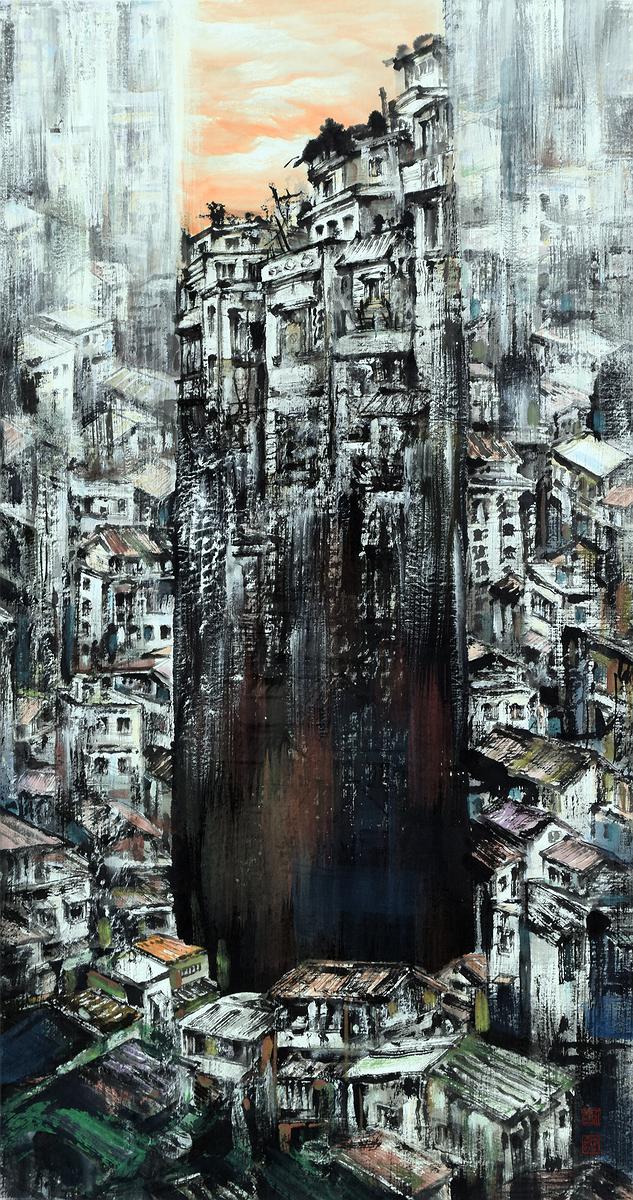
This thesis by creation focuses on “human” itself. Its concept develops from the living beings of Mother Nature (human beings) to the phenomena generated after their gathering (social events) and then to the surroundings they live in (objects). By doing so, the artist’s series of paintings discuss further ideas and experiences existing in social life. She uses the methods of repetition and structure as the expression of her works, which does not only explore the ways and forms of repetition and structure but also discuss them from the perspective of nature evolving with time. In her writing, the artist assembles related Chinese and Western painting theories as well as past research essays to figure out the influence of visual and psychological perception on paintings. In chapter two, the works and theories of domestic and foreign painters also serve as the reference during the artist’s writing and creating process.
In chapter three of idea generation and practice, the artist develops three series of art works : “Birth of Changing Phenomenon” , “Image of City and Country” and “Nature Evolving with Time”. By using the technique of “repetition” and “structure” and by joining Chinese and Western painting theories together, the artist tries to break down former regulations to “re-structure” her own thoughts; to do experimental paintings by combining irrational forms of expressions (abstract, semi-abstract, deconstruct and construct) with regular ink wash painting sketching skills (figurative). The artist first explains the concept of “changing phenomenon” and “conceptual phenomenon” , “figurative” and “abstract” and “sketching” and “spontaneous drawing”; then analyzes her practice of materials and techniques as well as the composition of her works. The artist’s creation concepts will be analyzed one by one in chapter four and this thesis by creation is mainly presented in two following ways: first, it is assisted by “image” and conveys the feeling through it; it uses the ways of “repetition” and “structure” to display ink wash paintings; second, it focuses on “image” itself and presents the nature by sketching real-life objects and internalizing the concepts into the works themselves. In chapter five, the artist concludes her works with self-reflection and outlook for her future performance.