Just like any other traditional paintings in Chinese, the form of meticulous Detailed flower and bird painting is changing by the influence of western art. Form objective to subjective, individualism dominants its’ format, topic, skill and materials. The drawings and the colors of traditional bird paintings can actually be changed. The author, except for inheriting the tradition and pursuing the real world under the bird paintings, which are his motivation of researching and creating, he is also finding an innovative way of express. As for traditional bird paintings, they record the reality based on the observation of mother nature, and transform the natural objects to lifelike images. To search for an anti-traditional form, the author has captured the flowers’ images, looking for the color changes of plants in the environmental changes. He also analyzed the contour and colors between similar, representative works of past dynasties, and then tried to draw with Chinese brush, which can create arbitrary lines.
There are five chapters in this thesis. The first chapter, the introduction, describes the motivation, purpose, content and methods of the study. Chinese bird paintings originates from humans trying to draw the natural beings in the aboriginal environment based on their impression. After civilization, people have come to paint flowers and birds on the processed household utensils, which are the beginning of bird paintings. During Tang and Song Dynasties, the invention of brushes and papers, coming along with better pigment and processing skills, bird paintings gradually became a sizable and systematic art. It had even been specifically introduced in the theory of paintings, inheriting the different ways, forms and skills from past to present. In this chapter, the author also picked 4 kinds of brushes, along with other non-writing instruments, to analyze the discrepancy when they are being drawn on different papers.
In chapter two, the author, before he started to create work, was studying the drawing method of bird paintings through different Chinese dynasties. He found that there are relation and commonality between the bird paintings and the eighteen-drawing methods, concluded in Ming Dynasty, used in the portraits of Han and Tang Dynasties. That is, the eighteen-drawing methods can be used in both portrait and bird painting, but the manipulation of brushstroke, traditionally, is limited in the center and the side of the brush. The author was also trying to break the tradition while searching a new way of line drawing.
Looking back the theory of coloring in different Chinese Dynasties, the author found that Chinese artists tend to paint depending on the species, and this way also become the coloring foundation in thousands of years. But, in the reality, the color of plants will change relying on various factors, such as time, place, temperature, and soil. The author also spent lots of time discovering the true color of different plants in Taiwan, and proved the fact, which is the essence of gene, that the color of some plants will be changed by the environment. At the end, he quoted the saying of European impressionists of 19th century, hoping to create work with a brand new coloring perspective.
In chapter three, the works of famous Chinese bird painters were introduced. To make readers easily compare and observe the difference of techniques, such as brushstroke, molding, coloring, in past dynasties, all related works were partially enlarged.
Furthermore, the author also emphasized on the changes of bird paintings after contemporary Chinese artists being influenced by western art, and partially enlarged these changes in the pictures. After the comparison between modern and tradition, the author then analyzed the line drawing of objects to apply on his creation.
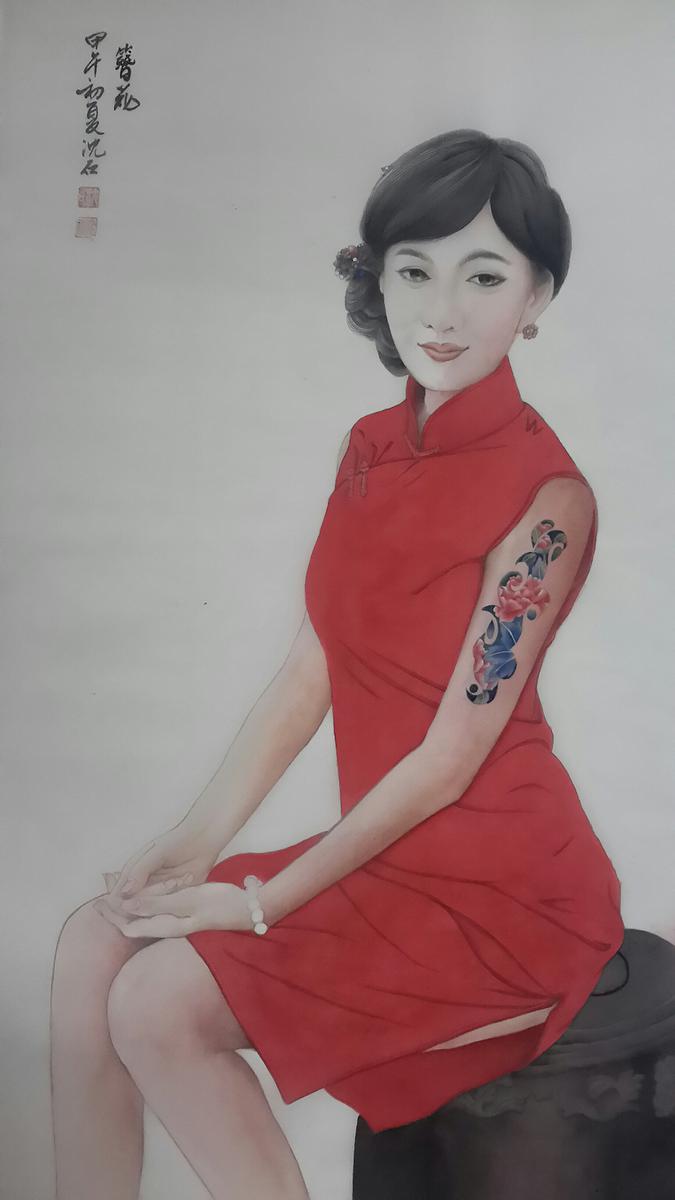
Chapter four describes about the ideas and explanation of creation. After studying Buddhism for years, the author noticed that the status of plants and flowers are usually being ignored by humans, who focus on animals more. But, as a Buddhism saying goes, “Having emotion or not, all creatures are equal.” Plants, which are also living creatures, change their appearance by seasons. For thousands of years, flowers growing in wilderness gradually convert to food and the decoration of household goods, making our lives become more colorful and interesting. To illustrate the outward changes of flowers, including the inward meaning of their lives, the author reduced his creation to four parts. The first part is life, depicting the beginning and the end of flowers. The second part, discoloring, expressing the emotions of flowers. The third part, wearing, is another way of expression by applying flower images on women accessories. The forth part, surrealism, redistributing the position of objects to make the pictures more like a story or a fable.
Chapter five, epilogue, reviewing the process of painting and writing to scheme the future guidelines of creation.