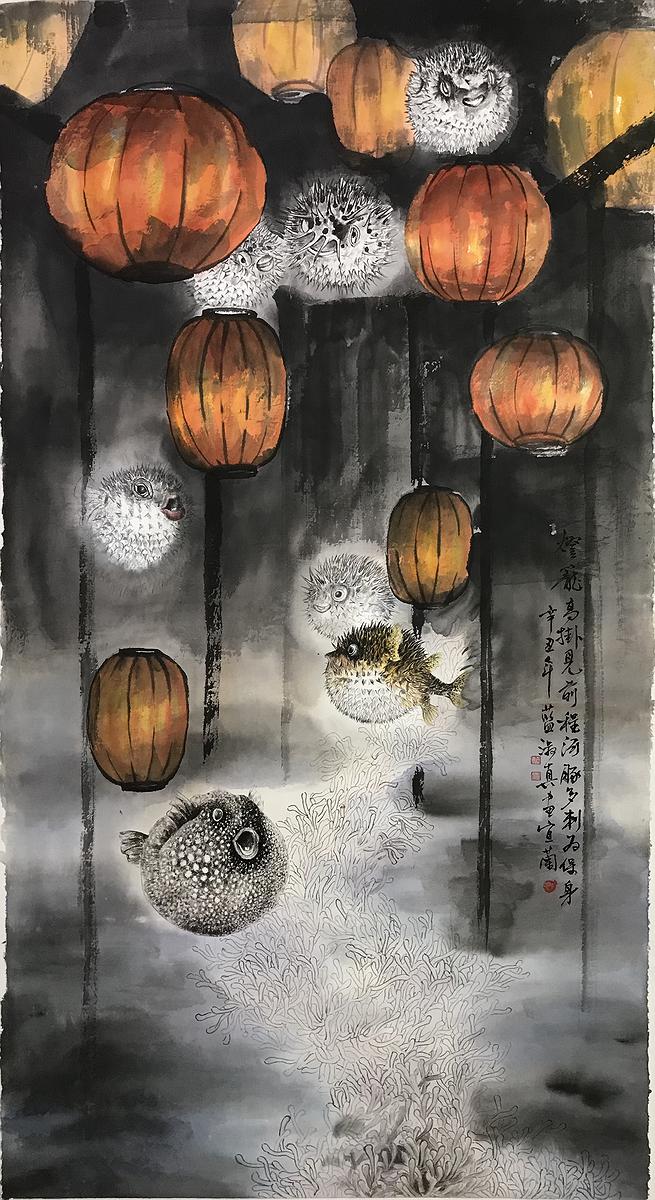
Aspiration is an indescribable state of mind unmeasurable with medical devices but keeps echoing in the mind of people. Can aspiration be translated into a work of art with art vocabulary through the process of creation?
In this thesis, the author investigated the position and traits of traditional women in terms of nostalgia and sentimental attachment to his/her mother. Traditionally, a woman’s affection is built upon sacrifice and devotion. Conditioned under patriarchy, women have no position in either the family or society. Even though they have a good marriage, their familial and social representation remain unclear. Restrained by the feudal code of ethics, women are under extreme constraints and suppressions both physically, mentally, and spiritually, and freedom is always an unreached aspiration to traditional women. From traditional times to modern times, from dependency to independency, women have gone through a long and winding road.
Based on the works exhibited at “Charm of Nostalgia and Aspiration”, the author investigated the helplessness, daily-life roles, and beauty in different time-space of traditional women in terms of literature review, observation, and iconography. In the Introduction, the manipulation of the thesis is defined in terms of the motivation, goals and objectives, and methods of research. In Chapter 2, apart from investigating the creative style of female artists, the ethos of traditional women is examined through the artist’s creation and observation. In Chapter 3, information in relation to the design concepts, style settings, and realization of creation of works presented at “Charm of Nostalgia and Aspiration” are consolidated and recorded. In Chapter 4, the author introduces the two series of woman-based works from this research: (1) sketches on women characters in which the emotional struggles of traditional women are narrated through nostalgic objects; and (2) symbolic figures of women expressed by means of metonymy and displacement in which women characters are replaced by symbols (icons) to symbolize the inherent aspirations of women.
Art as an emotional exchange is a form of non-verbal communication and a retrospection and enlightenment from self-awareness (realization). By translating women’s inner joy, rage, anxiety, aspiration, and yearning into iconic expressions, the author wants to start a non-verbal dialogue with viewers.