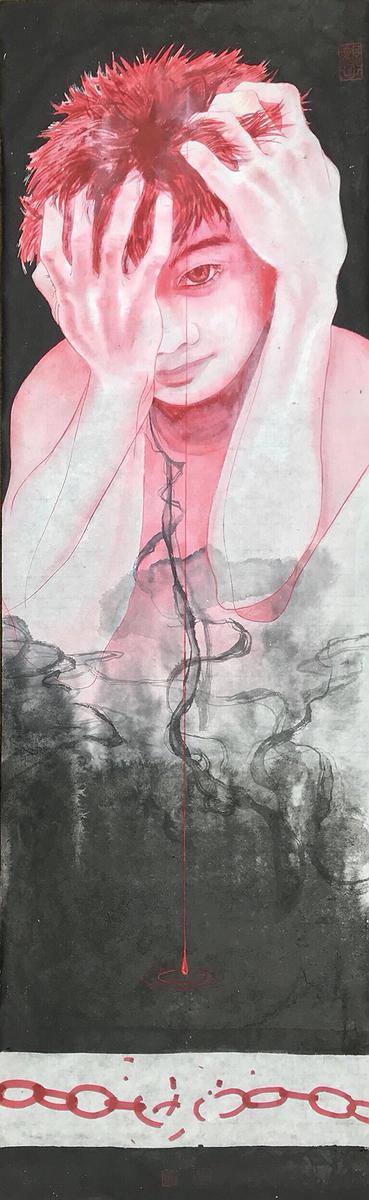
The concept of “Life Connection” is the process that the author continuously reflects the past and the present. This thesis records the author’s concept of creation from 2016 t0 2020, during which he keeps creating in the field of ink painting. From his subjective viewpoint, he describes individuals and the whole society in a unique way. On the other hand, from his experiences, the mentality seemingly vents feelings through creating. Since people live in a big group, the society, communication is an approach to keep in touch with one another. Realizing this fact, his graphic creations demonstrate non-verbal symbols by translating body language to creation language. This thesis reflects modern social problems and individual mental status. It not only describes the phenomena of information explosion, high speed pace of life, but also increasing inner pressure. Feelings are usually hard to deal with for some people, and they are usually not in their idealest status. Therefore, they tend to purify those negative parts by following teachings from religions, which helps conclude social events and strengthen relationships among people and in the end carries out the symbol delivering function of creation and interprets its meaning in the history.
This thesis combines art creation and discussion of religious scriptures news, and consists of five parts:
Chapter One: Introduction. This part elaborates motivations, goals, contents and approaches of research.
Chapter Two: Theories. This part analyzes the connection of gesture and body language theoretically. Besides, it also discusses the religious scriptures involved and current events.
Chapter Three: The Exploration and Realization of Creation. This part not only illustrates the influences from some artists, including Da Vinci, Michelangelo, Kathe Kollwitz, Xu Beihong, Zao Wou-Ki, and Liu Kuo-Sung but also compares works related.
Chapter Four: The Analysis of Thoughts and Works of Life Connection. This part specifies the meaning and the content behind all the works.
Chapter Five: Conclusion. This part covers the achievements, reflections, appreciation, future plans of creation.