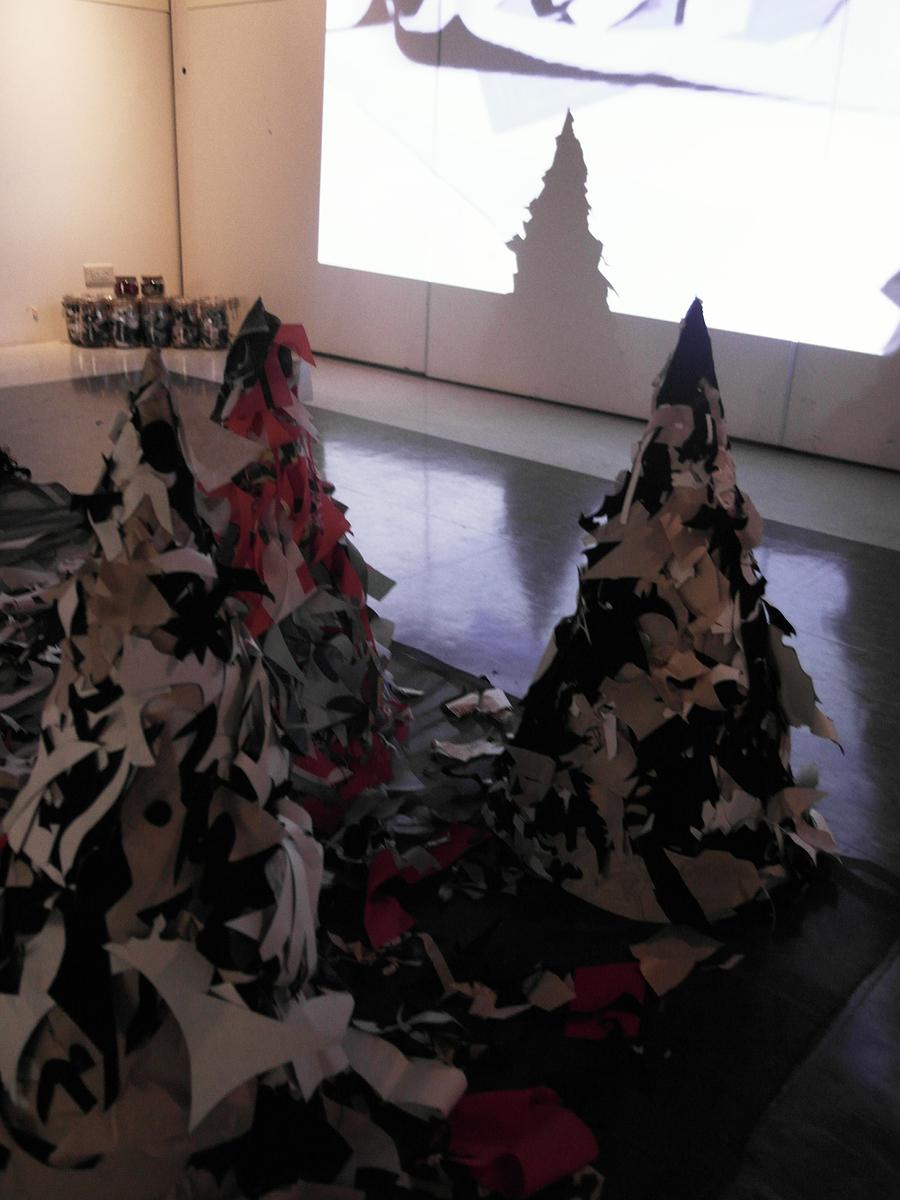
The goal of this research is to discuss the interaction of individual with its extended group culture and carry out this result to my work by observing the relation, effect and impact of individual with its surrounding.
Each individual’s body is a small space field, exists in an outer environment. Its independent yet dependent, unique existence in space, emphasizes the special interaction between the occurred, the ongoing and the outer space. The changes of generation, spread of the Internet, rise of globalization, broaden consumer culture, and other external changes, result in its powerful force for change, as well as dense packaging of predatory and mass hypnosis. These two interact with the stimulation of the intervening “Body,” making the body hidden, virtual avatar, culture mix and etcetera expand from the intangible culture to physical operation’s control and constraints in real life.
I, generation of the 21st century, live in Taiwan where it obviously confronts the qualitative characteristics of, in postmodern globalization terms, tradition and modernity, locality and foreign, misplacement and confusion. Nowadays, human community undoubtedly is forced to accept whatever is happened, due to the rapid spread and profound impact of technology, mass media, and consumer behavior. All these lead to fast, changeable, moveable, strange, momentary, repetitive, crowded, noisy, uncertain, bantered, and stimulating features.
Hence, by using the artist’s body as an axis and the environment as the width, the reactionary approach of re-carving constructs the creative ideas’ content and mix body’s issues. Under the condition of yearning and resisting, I intend to restore and shape the most complete “here and now” authentication from fractals, unboundedness, and avatar’s comprehensive exploration. It not only reacts oneself’s origin but also projects and speaks for the external space and culture’s consciousness.
This thesis includes five chapters: (1) Chapter I: Background and Motivation (2) Chapter II: The Themes (3) Chapter III: Materials & Methodology (4) Chapter IV: Analysis (5) Chapter V: Conclusion.