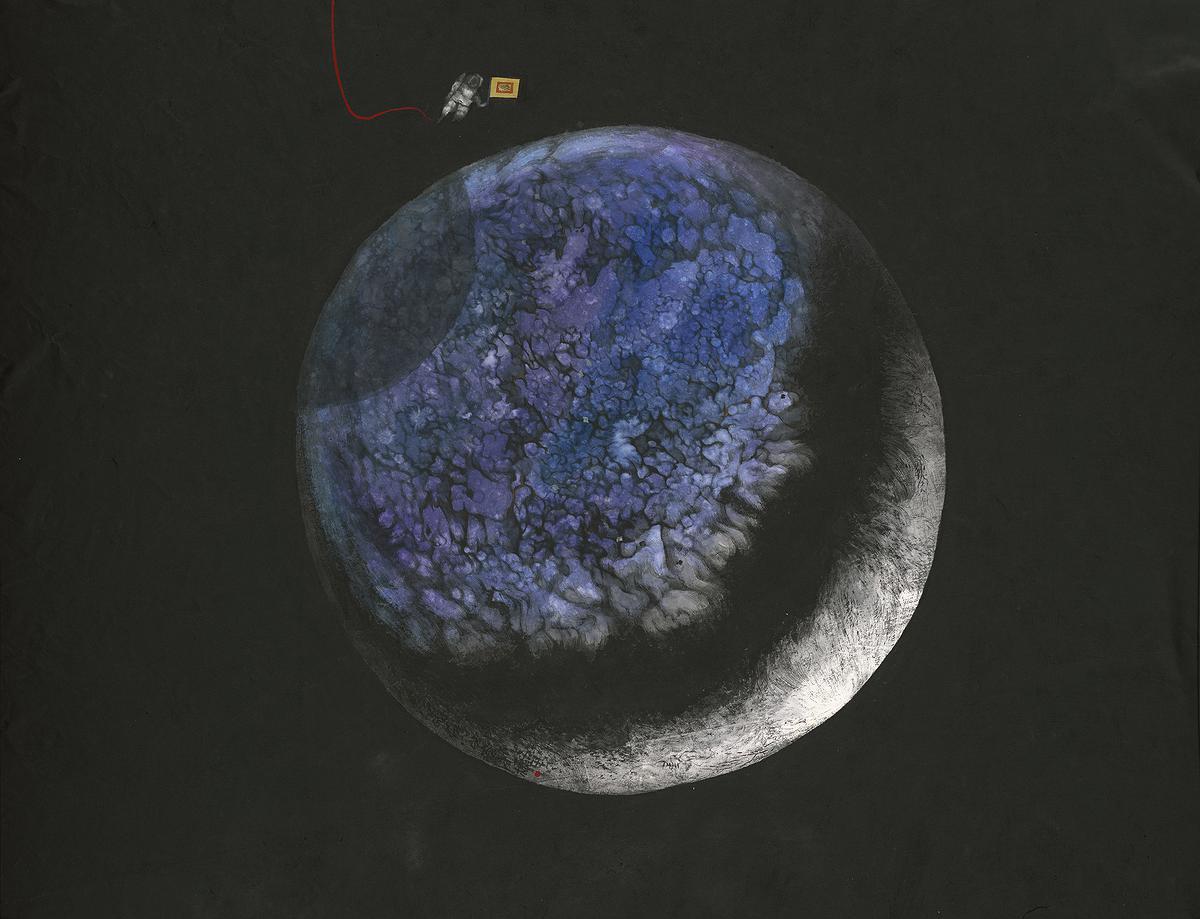
The motif of the present study, KEYGOT, dawned on the author when I was writing this MA thesis. The thesis covers two series, that is, “tiger” and “cosmos”—both of which adopt the religious elements in Taiwan’s folk belief: the joss paper, an object with which the author has been familiar in my family and surroundings since the childhood. Then, the Taiwanese term, KEYGOT, which denotes someone whose soul transcends his or her body in the Taiwanese belief, was invented in this background of the study.
The core conceptual part of the study will adopt theories coming from the Eastern and the Western religions, and then tries to organize and synthesize the theories in an effort to bring a more comprehensive thinking in both beliefs. Examples such as the social, the human, and the utilitarian attempts to rethink “belief,” “religion,” and “the religious.” Also, these attempts were made to rethink what conclusion can be drawn to select the joss paper into the picture, and how to maintain the traditional frame forms (that is, the “ink color” which means that the color occupies more portion of ink) in an attempt to break through the picture’s configuration, form, framing, and coloring while still keeping some portions of the tradition. By so doing, the oeuvre of the study synthesizes the personal viewpoint concerning the contemporary ink painting.
The focus of the study will be exerted on the artist statement, picture analysis, and configuration analysis. Chapter one, the introduction, mainly examines the research motivation, research objective, research content, and methodology. Chapter two is the theoretical discussion, which serves as the basis of the creation. Though theoretical, the overall scope of the study mainly addresses the methods and discussion concerning the space of the picture. Chapter three highlights the discussion of the concept of “white space” in the ink painting, especially the artist statement and analysis of KEYGOT. Chapter four is the creation practice of KEYGOT. For the two chapters mentioned above, the writing offers a rather detailed analysis and recapitulation about the topic of the study. Chapter fiver, the conclusion, offers a self-criticism of the study and the work, explaining the artist’s future creation directions.