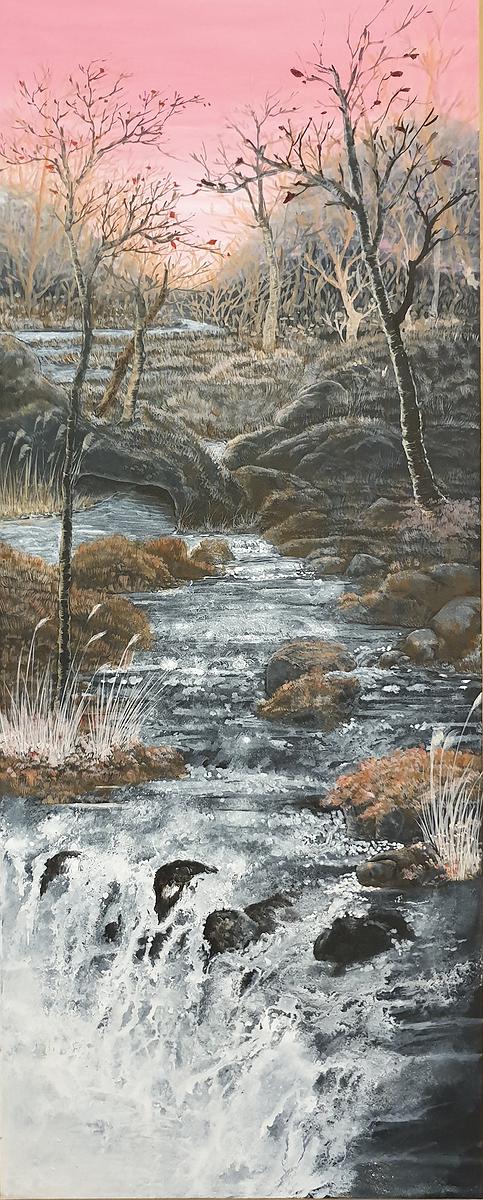
The title of this thesis was “Dreaming — Research on the Creation of Color Ink Situational Performance ”. The author aimed to convey the concern for emotional contagion or express inner feelings about human affairs via manipulating flowers, birds, butterflies and natural phenomena. He thought that aesthetic imagery provided vivid, lifelike images of animals and humans. In addition to manipulation of three primary colors, including pink, white, and gray, the artworks have been organized into the following four series.
1. Birds chirp and twitter : Display one's emotions, such as happiness, anger, sadness, and joy
2. Fantasy flowers and plumes: Illustrate joyful emotions via ecological Interactions among, human, plants and hummingbirds
3. Spiritual mind: Think from the perspective of human, bringing Lao-Zhuang thought into human interaction.
4. Splashing dreams: Describe the fantasy-like imaginative space.
The thesis is divided into five chapters. In Chapter One, Introduction, he claimed that the perspectives utilized in Chinese paintings differ from traditional European paintings. These differences provided the inspiration for the study. In Chapter Two he explored the theoretical differences and relevance between the Eastern and Western arts. Moreover, in Chapter Three, he explained the creative concepts and creative styles of the theme. Subsequently, Chapter Four dealed with an analysis of the artwork, and there were four sections in this chapter. The first section described people's emotional performance. He proceeded thus to the second section, which represents the relationship between flowers, birds and characters. As for the third section, he paid attention to the innovation of the emotional contagion. The fourth section is a comparison between dreamy and fancy paintings. Last, but not least, in Chapter 5, he offered a few theoretical reflections and the tendencies of future art.