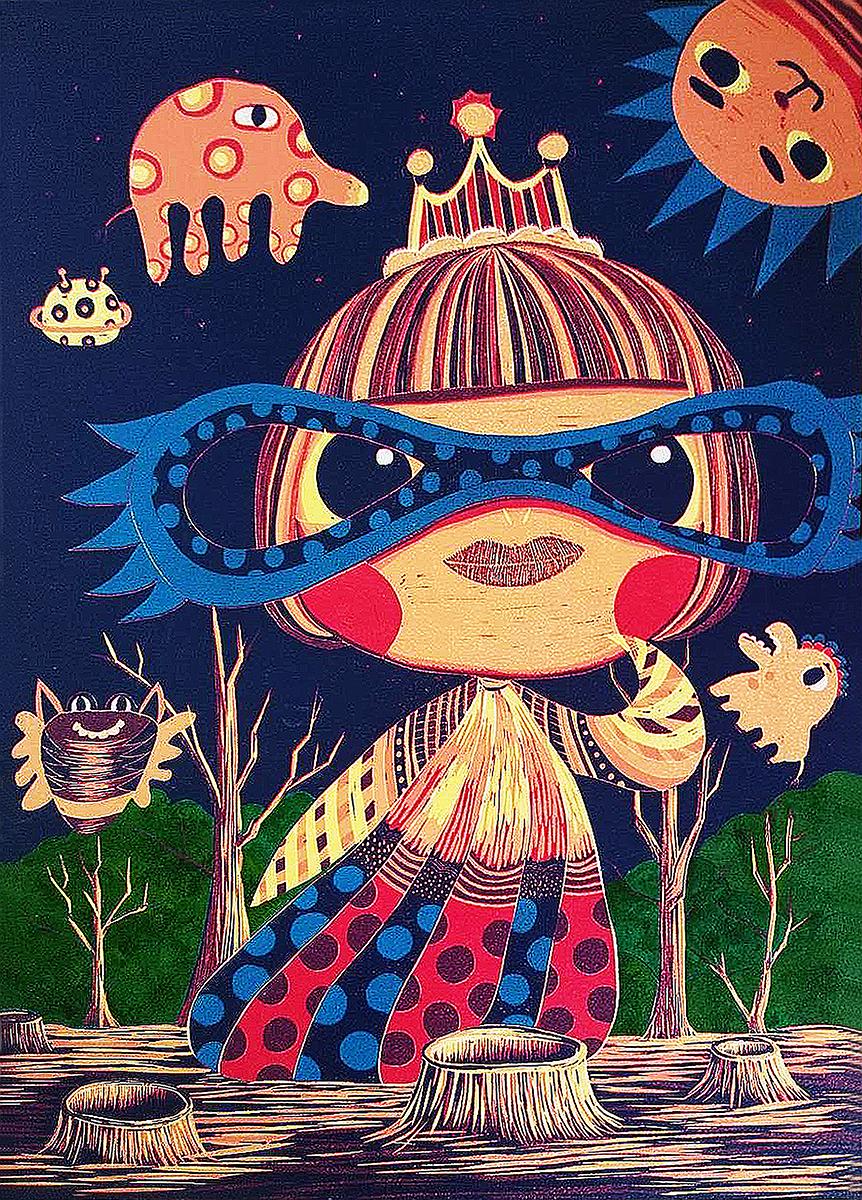
To begin with, “Fuzhou’s Life” is my creation during my graduate school. By utilizing the technique of “reduction printmaking”, I made prints as records of people and things around me in Fuzhou, and the reflections during my days in National Taiwan University of Arts. Furthermore, experiences gaining from this creation have become my motives to continuous creation in the future.
The inspiration of my art creations comes from my experiences of my daily life, which include my feelings toward people, and connections between people and scenery around me. Through the process of creating, I searched for the deep meanings and self-reflections from my creation. In other words, by constantly researching, I presented the graphic creation to review every stage of the meanings of my creation and the value of art.
My creation is mainly presented by relief printmaking process, and is supplemented by other methods to increase the enrichment of my creation. Moreover, with the techniques of reduction printmaking on EZ plate, and cutting, joining and stacking reduction the plate, I constantly found the possibility of every technique of printmaking. The technique of reduction printmaking is a counter-intuitive creation method. From the process of drafting and revising graphics, to the process of engraving and repeatedly printing, the colors were covered to the plate by layer to layer. Consequently, in addition to increasing the familiarity to kinds of techniques of printmaking, the completion of the creation expresses its overall imagery.
Through this research of creation, I established my unique way of creation and my attitude toward my life. I searched for self-positioning via the process of the creation, which made my framework of art even clearer and steadier. Besides, the process of the creation has become my motives to continuous create in the future.
The dissertation includes five parts. The excerpts are as follows.
Chapter 1: Introduction, including creation motives and purposes, researching scope, methods, frameworks and definitions.
Chapter 2: Discussion of psychology, symbolism aesthetics and the academic theory basis of the related artists.
Chapter 3: Creation practicing, including idea, contents of creation, selection of material operation of techniques.
Chapter 4: Analysis and interpretation of the creation, including the process of series of creation, Fuzhou Impression, I Fuzhou, Mysterious World.
Chapter 5: Conclusion, the overall review of the research purpose, and the future development orientation.