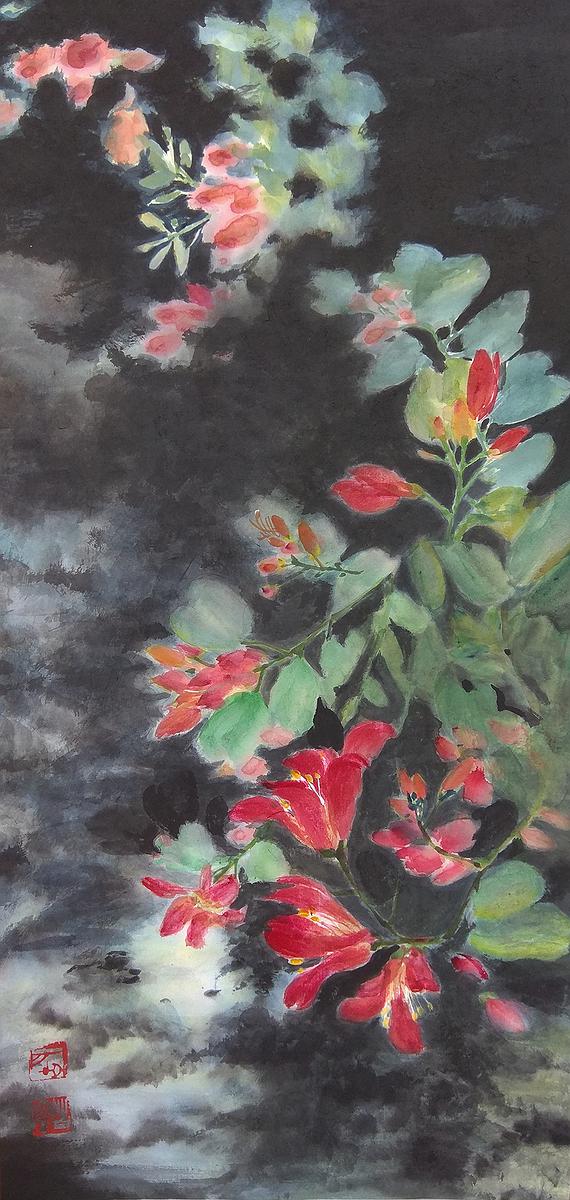
With “entrusting one’s emotions” as the key concept, this study examines how one can incorporate their life experience into the theme of their works. Basically, it means one can associate their emotions with or find some clues to their own emotions in the artworks they have created. All creatures are susceptible to the shift in the season and other environmental factors. When our ancestors expressed their feelings and thoughts through art, they often attached themselves to something. It is not merely an imitation of the nature; to them, the subject of their works were almost like a mirror. This study aims to explore the aesthetic theory of “entrusting one’s emotions” practiced in bird-and-flower paintings, a type of traditional Chinese painting, and to enrich my art and life by securing a footing in a well-established theoretical framework.
There are five chapters in this study:
Chapter 1, ‘Introduction,’ describes the long history of ink-and-wash painting that has become an icon of Chinese art and delves into the development of different styles and schools of bird-and-flower painting throughout history, trying to determine the characteristics of works that match the idea of “entrusting one’s emotions.”
Chapter 2, ‘Literature Review,’ combs through relevant literature on how “entrusting one’s emotions” is carried out in bird-and-flower paintings from different periods and the evolution of their different styles. By gathering information about the image management of bird-and-flower paintings, I can study and analyze the aesthetics of this type of painting.
A realistic sketch reproduces the form of the subject while inevitably capturing its spirit; a freehand sketch captures the spirit of the subject while inevitably reproducing its form. Therefore, the two seemingly opposite techniques are actually the two sides of the same coin. Mastering the presentation of the subject with the use of brushwork to organize and outline the image, I succeed in expressing my feelings. The form is lost in favor of the spirit; the form is simplified, whereas the spirit is fully conveyed.
In my opinion, a bird-and-flower painting should first and foremost reveal the intention and disclose the emotions of the artist through the subject. In other words, the true feelings of the painter should be communicated in the depiction of the subject, thus achieving the combination of the emotional and the physical and the union between the other and the self.
Chapter 3, ‘Exploration of “Entrusting One’s Emotions”,’ looks into the application of the theory to bird-and-flower paintings, especially in the Shanghai School and Epigraphy School that had a great impact on contemporary masters. The key figures in question are Ren Bonian, Wu Changshuo and Qi Baishi.
Chapter 4, ‘Analysis of the Works,’ discusses the two series I have completed. A Reflection of Life focuses on my observation and ink-and-wash representation of particular images and impressions in daily life. The Fragrance of Flowers makes flowers a metaphor for people and things, redirecting my inner feelings to the subject. The transference takes place out of pure need. Between subjectivity and objectivity, sense and sensibility, the activity of the mind becomes food for art creation.
Chapter 5, ‘Conclusion,’ sums up my vision of the future as an artist: I shall always keep up the work and accumulate more resources for my art.