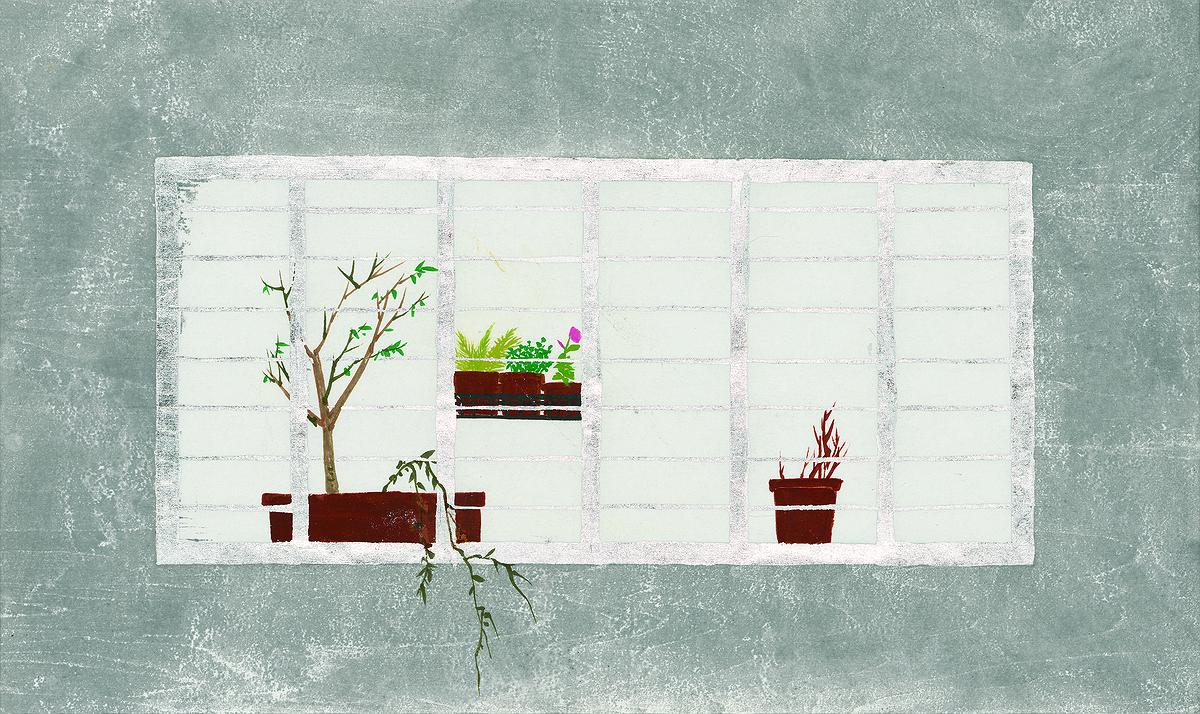
The main purpose of this study is to explore how to create mental scenery in urban life with a dense population through a “dream journey.” In this paper, potted plants grown in cities are taken as observation objects, and the urbanized living environment is quite different from the idle life of literati in the past. However, the author believes that the “dream journey” has not disappeared in today’s society but has transformed to exist in the contemporary world. The “dream journey” in the development of Chinese art history came from comprehension using one’s own heart and reflects the inner world of literati through landscape painting. In addition to examining this process, the author brought the urban landscapes observed in daily life into printmaking and investigated how to reflect on “mental scenery” through printmaking; thus, the current research and creation came into being.
The author will put forward how to make intellectual inquiries about printmaking media. Regarding the practical problems arising from copying pictures and printmaking, the author tried to clarify the multiple problems found in printmaking by combining personal experience and comparisons to the works of printmaking artists Xu Bing and Chen Qi. This paper posits concept of a “modular system,” analyzes the production modes of printmaking media, explores the boundary between digital printing and printmaking with “digital printmaking,” and reflects on the expansion of printmaking media.
This article will also take the author’s printmaking creation as an example to analyze the subject’s forms and techniques, delve into watermark woodcut techniques, and practice the art of Gong Hua. Taking “mental scenery” as a proposition, after reviewing the cases in the history of art, the author analyzed the topic using personal observation and practical experience so that the spirit of the dream journey could enter the work. The author hopes to create personal mental scenery through the work and simultaneously reflect on the connection between the author’s creation and the above points so as to provide new meaning and possibility for the “dream journey.”