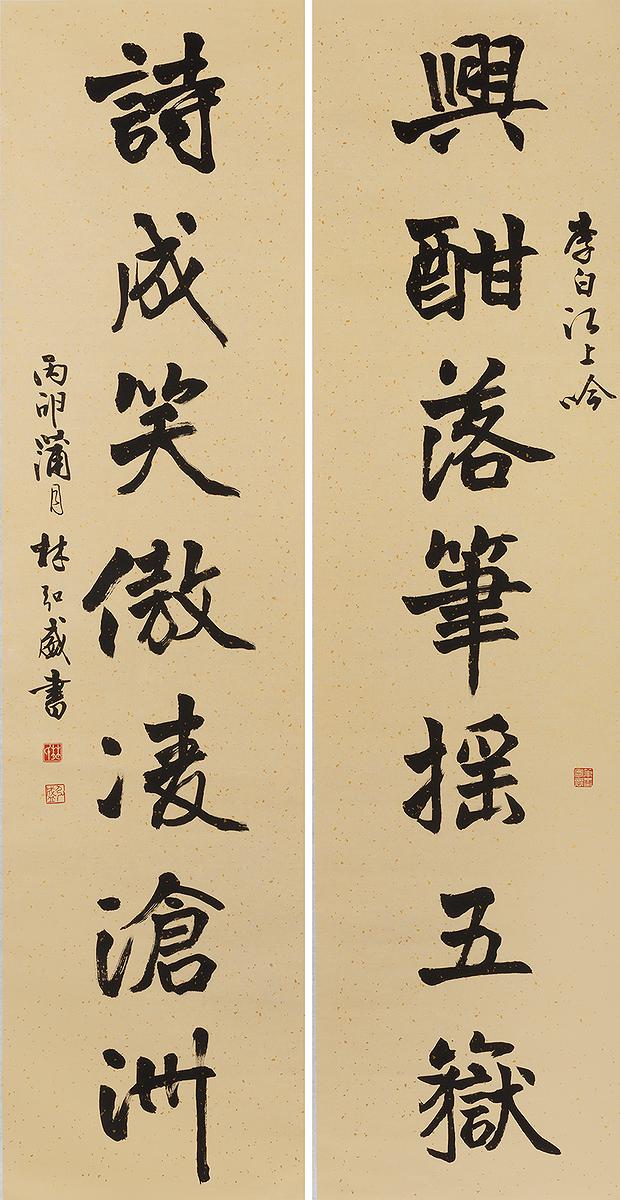
Qing Dynasty is one of the most important periods in the history of calligraphy. Begin from ‘Southern and Northern Schools of Calligraphy’ (Nanbei shupai lun) and ‘northern stele and southern letters’ (Beibeinantie lun) of Ruan Yuan and mid period of Qing Dynasty, the Letters tradition of Beixue and tiezue pattern formed. Tiezue letter changed from flourish to decadence and whereas Beixue became the major script and has a significant place in the history of calligraphy.
This study mainly focuses on steleology, and began with ‘Si Ning Si Wu’ which proposed by calligraphers Fu Shan and Wang Duo during the end of Ming dynasty. Due to factors such as change in society, distortion of carved post, and raise of epigraphy, calligraphers have launched calligraphy reformation which were based on ‘clumsy’, ‘thick’, ‘ancient’ and ‘plain’ to pursue vintage aesthetics and magnificent appearance of the new style of calligraphy
However, this new aesthetic trend has promptly been temporary phased out by the political power of guangeti calligraphy and literary inquisition in the Qing Dynasty till the raise of Jinshi, which Ruan Yuan proposed ’Southern and Northern Schools of Calligraphy’ (Nanbei shupai lun)’ and ‘northern stele and southern letters’ (Beibeinantie lun), the trend of vintage style has returned, and followed by Chung Shih theory of PAO,SHIH-CHEN and steleology of Kang Youwei, his calligraphy works Guang Yi Zhou Shuang Ji at the time is rather influential, and inscriptions of six dynasties were considered all equipped and covered, moreover, undertook the memorable stylishness of Han Dynasty sub-scribe which can be said as the respected matter of six dynasties inscriptions. He has organized six dynasties inscriptions organization into 〈Ten Calligraphers〉,〈Sixteen Generations〉, 〈System〉. Volume IV in particular introduced the style of each inscription, and could be treated as an importance reference in the learning of Beiban chirography. Chapter two and three of this study has further carried out philological study on each of the inscriptions, and table has been created for easy reference. Books which has Beibei font as an important writing template has difficult position since ancient time, and has few discussions in the past. Whereas, the learning methodology and aesthetic of Kahn has its unique style and insight subtlety which will be explored in detail in section 4 of chapter 2
Chapter three carried out formal analysis and concept explanation on creative concept or creative technique. This include Round style and Rectangle style in practice, exploration of shushi, tryout of differential mode, the new state of rubbings merge topics, which assist in the clarification of creative concept, and achieve mastery through a comprehensive ancient thought. Chapter four and five are the presentation and impression on writer’s work, and self-expectation of future creation.