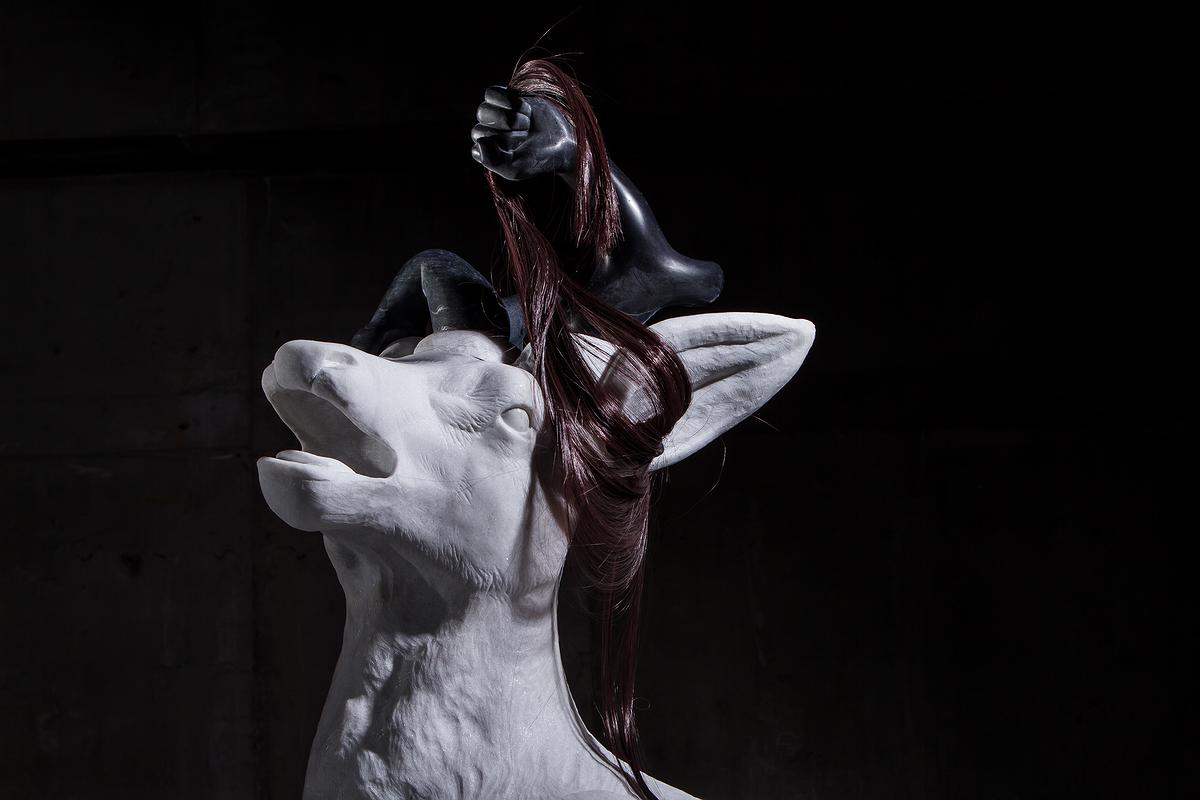
The author has chosen stone carving as a way to create sensory experience and respond to today’s artistic atmosphere. He employed the techniques of Realism with great finesse, in order to demonstrate a variety of issues concerning human desire and the life of animals in modern times by carefully describing how animals are persecuted and mistreated due to power asymmetries, and how humans tend to harm or even kill other animals in order to satisfy their own desires. Due to the reasons outlined above, this paper mainly discusses the artworks titled as “Red Wine Series” and “Chinese Herbal Medicine Series.” The reason why desire was symbolized by “red wine” was because the author felt a surge of desire when he sipped red wine and intended to use some descriptions from mythology to create a correlation between red wine and sacrifice, blood, power, and hierarchy from ancient times to the present day. As red wine is combined with stone sculpture, it can produce a sanguinary representation, whereas the viewer’s past memories can be evoked due to the Proust effect. This way, spectators can have multi-sensory experience when viewing the artworks. Meanwhile, the moldy, decayed red wine reminds us of temporality, which can also be seen via the sculpture itself. To accentuate the hues of red wine (as well as its fungus), the author chooses white marble as the material, while chiseling animals in their incomplete forms, in the hopes of conveying a sense of grief and sadness. These carved animals are represented in the forms of dead specimens or being hung upside down—metaphorically the death of physical bodies and human supremacy. With regard to the Chinese Herbal Medicine Series, the sculptures that emulate the form of soaked specimen or mini-monuments are inspired by how Chinese medical wine absorbs the essence of life, and can be regarded as responses to the interpretations proffered by Damien Hirst (1965-) in his Specimens Series. The author would continue to create other types of stone sculptures, so as to produce more artworks besides the Red Wine and Chinese Herbal Medicine Series that stress the sense of smell, and stretch beyond the boundary of stone carving.
- Image
- Media Design
Please click or press enter on the picture to view the picture