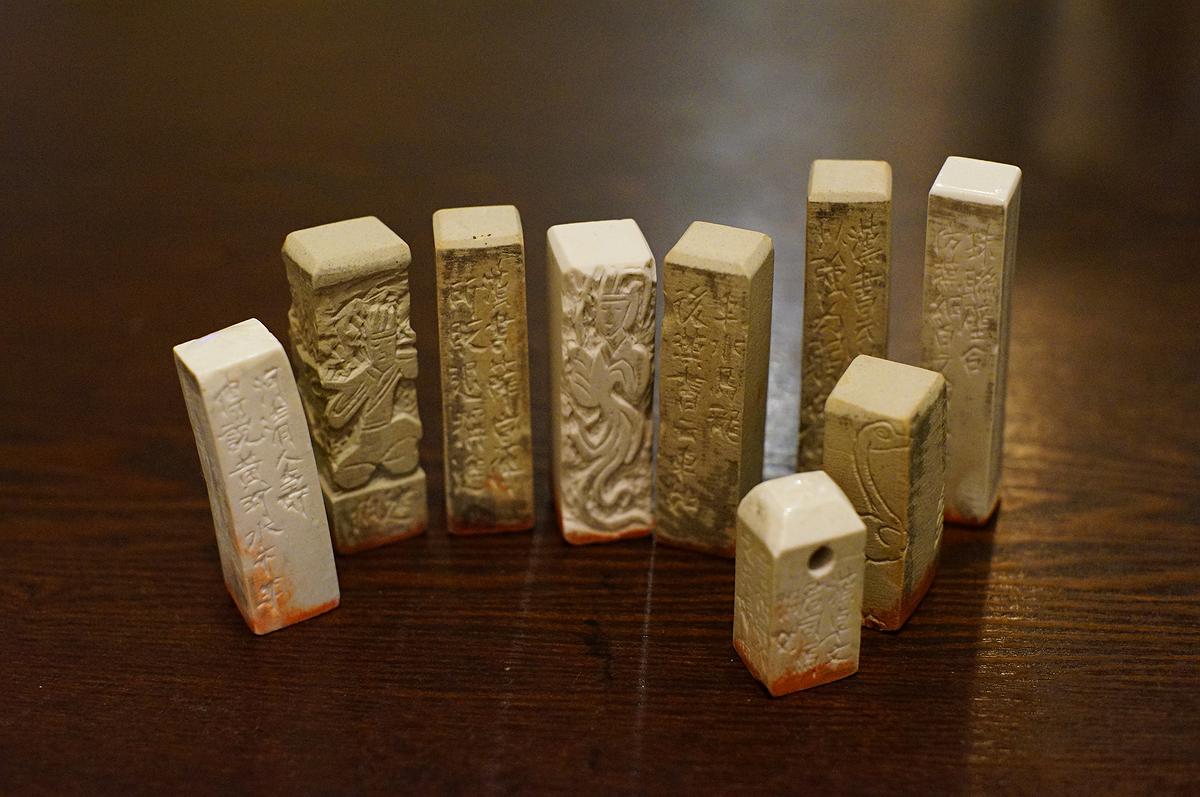
The art of seal cutting has been made on stone seals since the Ming and Qing dynasties. Throughout the history, outstanding seal engravers have claimed to “follow the example of Han Dynasty seals,” making the aesthetics of the seals an example to seal cutting learners. The study aimed to create seal cutting with the method of ceramic art, featuring “Han Dynasty seals” and “the artistic form of the Han Dynasty.” Additionally, different from stone seals, the study exhibited different features derived from ceramic materials.
Theoretically, the study probed into the academic bases of Han Dynasty seals, sealed mud, Chinese calligraphy in the Han Dynasty, pictorial seals, Han bricks painting and ceramic art with the method of induction in the hope that classic elements could be transformed into nutrients for the artist's creations. Moreover, the artist adopted the method of deduction for seal cutting and ceramic art creations to comply with.
Practically, the study obtained connection between ceramic art and seal cutting. The artist used wood kiln firing in particular to make ceramic seals novel. The transformation process of texts can be seen in Beyond Freedom—a work from wood kiln firing words to Heart Sutra, while the evolution process of pictures can be seen in Pokemon—a work from wood kiln firing pictorial seals to Pokemon Go.
The study provided some directions and experiences for those who are ambitious to engage in seal cutting with ceramic materials based on the results of the study. Due to different materials and techniques, Han Dynasty seals, sealed mud and pictorial seals presented diverse textures and styles, showing sixty three types of ceramic texts. Meanwhile, numerous artistic skills were adopted on seals such as kilning, glazing, ink rubbing, seal knob style and carving to change the manufacturing methods and appearances of seals, and twenty two works were thus produced. Among these works, eight features including Chinese calligraphy shown on seals, the blending of cursive calligraphy and seals, the side carving of seals with the style of prints, the side carving of seals with the classic style of Han bricks painting, the mottled style of sealed mud, carving style, novel pictorial style, and wood kiln firing style are worth mentioning.
The ceramic seals of the study show that the art expressions of ceramic seals were not inferior to those of stone seals. Therefore, if the artist can keep improving seal cutting and ceramic art and blend these two kinds of art, it will be a new trial and a new opportunity as well.