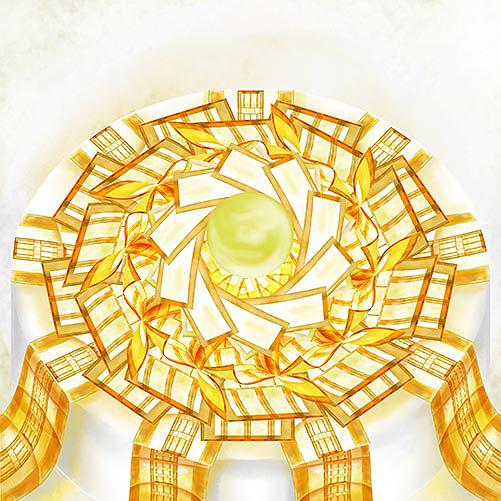
Mandala originates from the altar where sacrificial offerings are burnt and is not related to the flower Datura. Mandala appeared with Indian Vedic culture ; at that time, it was only the method of building altars. After the rise of Buddhism, the Buddhist scriptures were added with illustrations or paintings. Later, the Indian Esoteric Buddhism combined the cultures of Hinduism and Buddhism cultures, and the paintings of Mandala appeared. In the period of Tibetan Buddhism, the altar in the Hinduism is transformed into the palace and pavilion of Mandala, which are combined with characters and stories of scriptures to form a tool for education, whereas the doctrine is interpreted using images and shapes. The "mandala" art in Tibetan Buddhism expresses the concept of scripture and practice through the altar and amulet in Hinduism and the lotus in Buddhism as well as the geometric structure. It can be seen that Mandala symbolizes meaning through shape and the logical use between visual expressions. In fact, it is very close to the concept of abstract shape. The abstract is like the ice crystal in the snow which is used to explain the meaning of snow. Similarly, Mandala explains the visual meaning of the scriptures, allowing viewers to rapidly enter the narrative in the scriptures so as to achieve the purpose of understanding.
Therefore, the researcher uses the form of Mandala that is combined with the concept of life in the Bhumi literature and the geometric abstraction to create the computer graphics Mustard Series and the showcase SUMI Series in order to express the process for people to achieve consummation in the life.
The research finds that, with the geometric form as the basis, after the transformation of the form using Adobe Illustrator, the coloring begins. If irregular shapes or occasional abstract form are added, there will be more possibilities. Even in expression, when the actual painting techniques are combined with the virtual computer paintings interwoven with each other or the differences and uniqueness of the materials and even the printing methods, then the value and meaning of the works will increase to create more Mandala patterns.