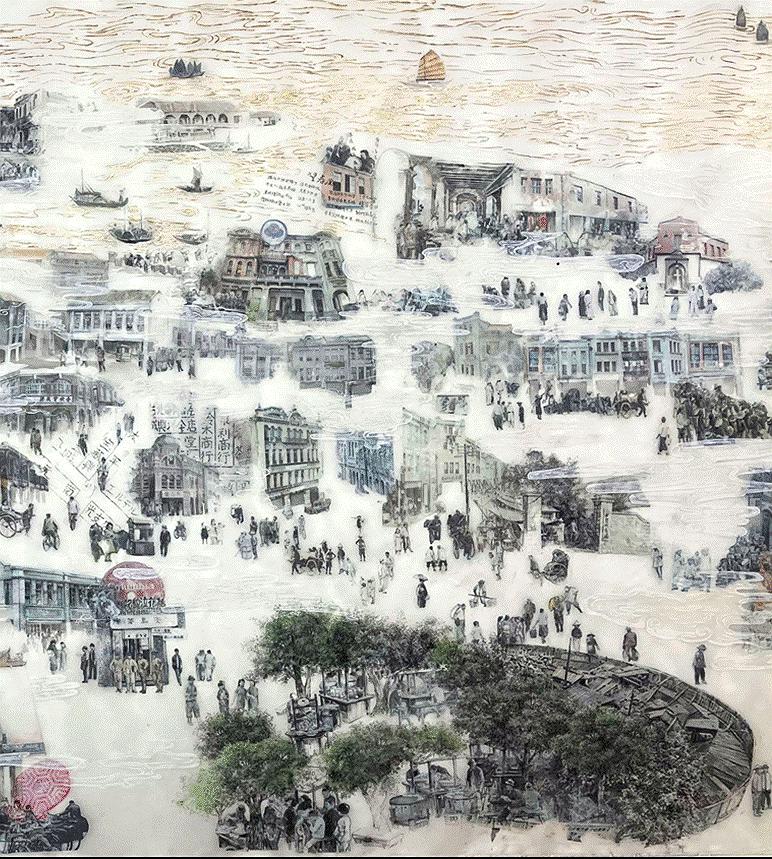
Historical architecture and urban landmarks serve as concrete witnesses of time and constitute vital carriers of collective memory. Within the intertwined contexts of history, politics, and cultural identity, such spaces often become sites of layered interpretations and modes of viewing. Pierre Nora’s concept of lieux de mémoire (sites of memory) emphasizes the convergence of history and memory within specific locations, which in turn form the foundation for identity construction and cultural narratives.
This study focuses on Dadaocheng, Taipei, as its primary site to examine how historical imagery can be reinterpreted and reconfigured through contemporary artistic practices. The visual materials accumulated across different historical periods—from the Qing era through Japanese colonial rule to post-war modernization—reveal not only the evolution of urban landscapes but also the stratified structures of social and cultural power. Drawing on Robert Smithson’s theory of “non-sites,” this research explores the potential of images to generate new meanings once removed from their original contexts. Additionally, W. J. T. Mitchell’s perspective on the agency of images is adopted to frame artistic creation as an active engagement in the reconstruction of historical memory.
At the practical level, this study employs strategies of image reconstruction and visual collage, extracting figures from historical imagery and recontextualizing them within hand-drawn scrolls. This process constructs a nonlinear and non-narrative temporal structure in visual form. The creative output comprises three components: (1) Dadaocheng Scroll, which reconstructs urban memory using historical imagery from 1850 to 1945; (2) Artist’s Book, which documents the creative process, including compositional development, material experimentation, and formal transformation; and (3) Stylistic Exercises, a series inspired by Raymond Queneau’s Exercises in Style, which explores the fluidity and generative potential of visual language through experimental image variations.
By integrating artistic practice with image theory, this research addresses how historical memory may be sustained and transformed within the context of contemporary visual culture, and proposes art as a potential method of historical intervention.