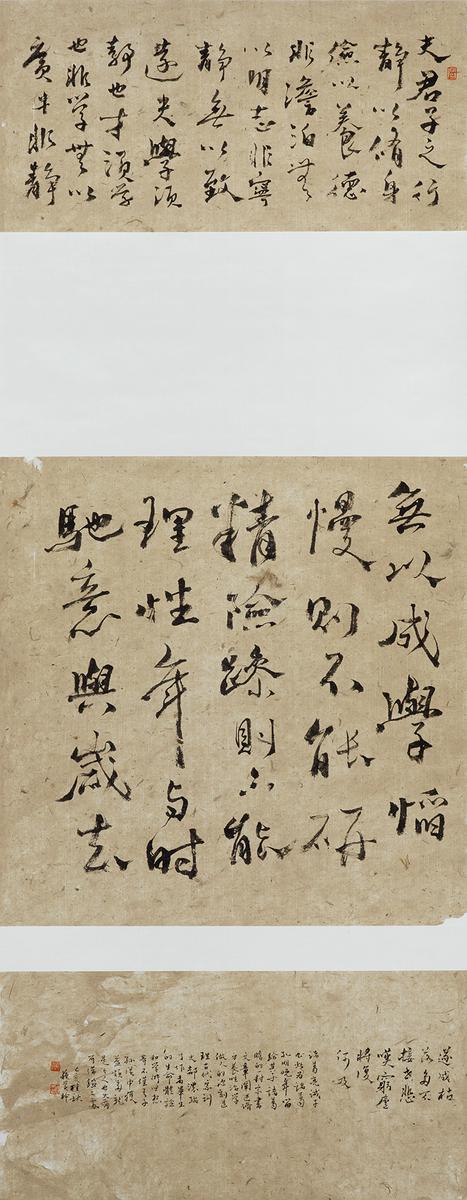
Although we seem to be situated in a peaceful era, we feel unrest at heart. At this moment, it is better for us to grasp our true hearts and elevate ourselves. In ‘Concerning the Spiritual in Art,’ Wassily Kandinsky thinks that art and the human spirit interact with each other. When the human spirit guides the robust life, normally speaking, art is exceptionally active at that moment. It explains how art helps people to become passionate, solving difficulties and bondage in life. Restoring the spiritual freedom, it helps people regain a perfect and solid life.
In this thesis, the title half Acre Pond is inspired by Zhu Xi’s “A Thought on Viewing Books” – “A square pond of half an acre” is eternal because there is living water coming from its source. The writer is enlightened: With origins, people are eternal. Without any origin, they’re dry. People can retain the essence of life if they introspect themselves from time to time. Then, artists can create vivid calligraphy art.
Examining the philosophical spirit of the “wandering mind,” the researcher is able to collect the energy and transform the limited space on papers to become infinite terrain for free-minded artistic creation. Writing strokes and lines freely, she re-discovers the essence of life and calligraphy. She gains endless energy for artistic creation, wandering in it.
The thesis consists of five chapters. Chapter 1 analyzes and summarizes the motivation, purpose, contents, scope, and research method in this study in artistic creation. Chapter 2 examines the theories. Section 1 and 2 discuss the philosophy and theory of “wandering mind” and the method of literature review. Section 3 discusses the theory and thinking of the researcher. The mind as the point of departure transforms into the energy of artistic creation emerging from the endless spirit to wander in calligraphy. Chapter 3 is the concepts, contents, forms, and features of artistic creation. With the essence of traditional culture as the foundation, it aims to inherit the tradition of calligraphy to make innovation in the modernity of calligraphy, trying to seek personal symbols in calligraphy creation. Chapter 4 records, analyzes, examines, and reviews the researchers’ works in four series; “Archaic and simple interest,” “Wander freely in spirit,” “Wander at heart to narrate,” and “Images of wandering mind” explores the possibilities of calligraphy creation. Chapter 5 concludes the thesis. It reviews and examines the findings of calligraphy creation in this thesis. It is hoped that the researcher can elevate her future artistic creation and understand herself better with the benefits from this research. It is expected that the researcher can truly face herself in every calligraphy creation, live out herself truly, and freely wander in the space of calligraphy art.