Spatial processing is the course which all artists must undergo. Creators have to face tests and experiences on how to arrange the space and how to exhibit and express
self advocacies through space. The mutual influence between the space and creators gradually become the issues which the artist urgently intends to analyze. The creator expects to put self consciousness into closed space and then to discover oneself from within, in addition to connect self-consciousness and the space for aspiration, followed by decomposing oneself eventually. The creator intends to explore into self mental image through this form of manifestation and to transform into possibility of
3-dimentional work through re-construction.
The direction of this creation is based on the “Spatial Poetry” produced by Gaston Bachelard (1884 –1962) and translated by Gong, Jow-Jiun (2003), which captures three different directions of discussion: house image, miniature and drawer dimensions for questioning and creation. The artist also applies the negative space mentioned in the paper, “Negative Space of Sculpture and Entropy: The Creations by Rachel Whiteread” written by Huang, Mu-Yi, as the framework of creation, in attempt to analyze the spiritual status and sub-consciousness of oneself in order to search for issues of creation. Later, the artist connects self-consciousness and the space to carry out creation aspiration, in attempt to explore into oneself from the process and to re-acquaint the private “me.” Using the series transformation undergone in spatial exploration that depict the inner manifestation the corresponding physical and virtual relationship, the work can mostly present the most in-depth appearance of the artist.
“Drifting Space” is the theme of the artist’s creation, which is also the portrait and review of the artist’s own state. The theme originated from the childhood memory and the inner reflection of the artist in recent years. The dependence of the artist on space due to the drifting and moving courses for years has resulted in two different emotions: the pursuit of miniaturized space under the impulse to search for “self-existence” from past space or existing space. The other emotion is the “fascination” produced by the perception of inner anxiety and restlessness. The state resulted from the two different emotions become the best reflection of the artist and also the theme which the artist intends to express.
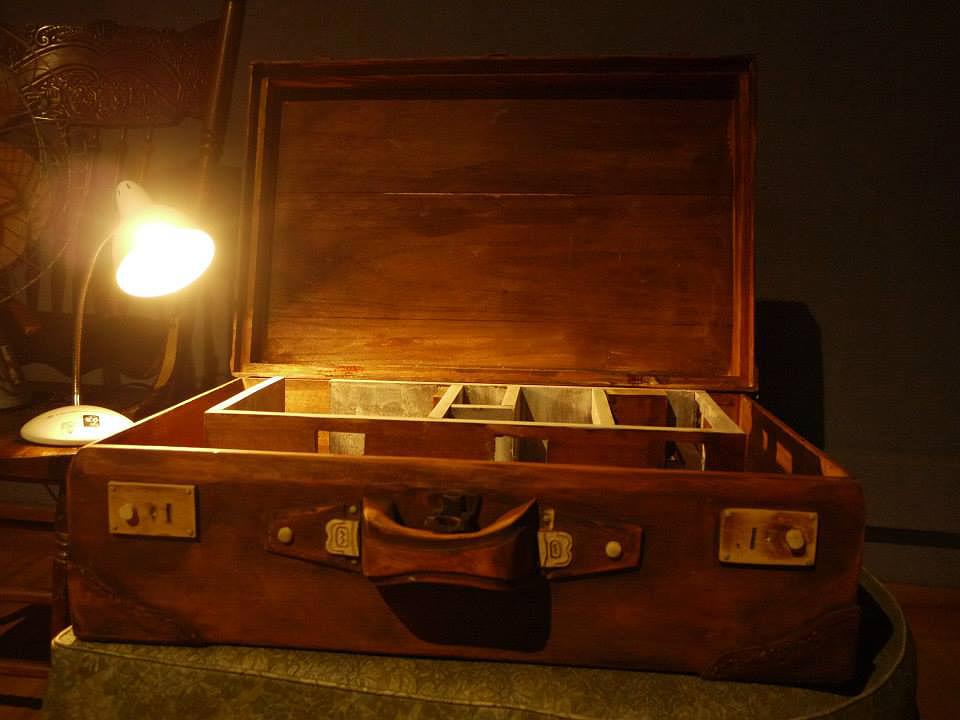
With respect to creation form, the artist applies the furniture as the carrier and uses it as a metaphor of the subject to carry out self-analysis and create his own symbols and vocabularies of arts. The artist uses the items once used or collected as the creation basis in attempt to cross the boundary between pragmatism and pure appreciation through reconstructing, placing and coloring these objects, so that the works will exhibit the artist’s world of mental image.
The manifestation techniques are montage based and the main structures is embedded with dowel to strengthen the framework and enhance stability. The artist intends to correspond to his intrinsic state through the surface meridian of creation materials. Using mottled and non-exquisite processing methods to carry out the piling and construction, the artist attempts to highlight the seemingly smooth spiritual state that has actually been riddled with gaping wounds, from the form of imperfection.
The artist attempts to break self-bondage through a series of questioning and creation to build his own vocabulary and advancement in techniques, developing a proprietary creation styles from his works.