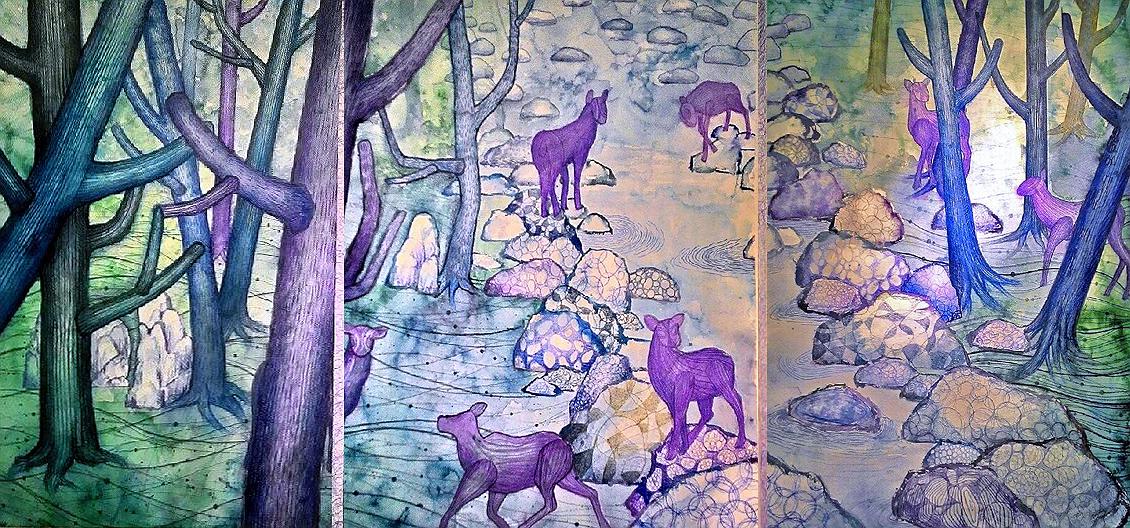
“Strange Tales of Liaozhai” is a well-known Chinese literature because of its narrative thinking element. The artistry and literary value are highly appreciated by scholars and critics around the world. Virtualizing some creatures called magical foxes, beasts and immortals which spiritually possesses human and control their minds to do bad things, the political darkness and some unfairness accompanied by human activities in reality are deeply reflected. Unlike some Chinese traditional conservative novels, “Strange Tales of Liaozhai” is written in entirely different style that makes literature industry fresh and new. Unsurprisingly, “Strange Tales of Liaozhai” is acquired as the first tier Chinese Classic novel reputation. A well-developed story not only can be presented literally, but also can be demonstrated by ILLUSION, which is the principle of this research. Illusion is generally clarified as a supportive role in literature. However, this research displays the poetic imagery of “Strange Tales of Liaozhai” by ONLY using illusion associated with critical thinking, different imagination and diverse techniques.
The research aims at investigating the various presentation techniques, formats and patterns of freehand illusions, which is then applied to “Strange Tales of Liaozhai”. There are three concrete targets among the research. First is to discuss the contents and implication of “Strange Tales of Liaozhai” and the illusion styles at all times. Second is to analyze different kinds of illusions related drawing abilities, develop line-based technique of expression and apply a special drawing style in which various decorative design patterns are used to present the “texture” of the illusions. Third is to pick twelve interesting segments of “Strange Tales of Liaozhai” and create corresponding illusion for each with brief explanations.
The research emphasizes that hand-drawn is the core component of drawing illusion, designs distinctive form and composition of drawing features and shows a powerful, unconstrained and imaginative world. On top of the hand-drawn skills, “points“ and “lines” forms are utilized to introduce the hidden messages of the illusions. Consequently, the rhythmic and fantasy aesthetic feeling is composed by those smooth and delicate lines. Also, a special texture effect is described through the usages of multiple artistic media and materials. The initial results are concluded as follows:
(1) After analyzing and comparing different “Strange Tales of Liaozhai” related illusion samples, we recognize that creators have their own presentation ways. No matter which ways, most of illusion works are traditionally functioned as the assistant role. Therefore, the artistic characteristic of illusion itself is not fully created.
(2) Twelve illusions are created according to twelve tales of “Strange Tales of Liaozhai” and divided into two branches:
(i) Human and Ghost Theme: “A Mini Human Inside Ear”, “Farmer”, “Mandarin Orange Trees”, “Gold Ingot”, “Drunk Ghost”.
(ii) Animals and Plants Theme: “Clamshell”, “Flying Cow”, “The Revenge of Butterfly”, “Revival Herbs”.
(3) In addition to the outlines and structures, more efforts are put on demonstrating the textures of the illusions. All methods are summarized as bellow:
(i) Point Drawing 1-------Fine Dots.
(ii) Point Drawing 2-------Heavy Dots.
(iii) Line Drawing 1-------Drawing with ink and brush only.
(iv) Line Drawing 2-------Decorative Lines.
(v) Line Drawing 3-------Texture Express.
(vi) Wash Drawing.