Taiwan possesses rich cultural resource and the southern city Tainan is served as the basis of Taiwanese culture. Tainan has become a modern city after three to four hundred years of development. During these periods, Tainan went through different aspects of transformation and improvement, from agricultural society to prosperous city, from commodity industry to era of domestic goods, from the colonization of Japanese government to the rule of ROC. Abundant cultures and lives of Taiwanese inhabitants are recorded in this historical city, Tainan. Though these Taiwanese inhabitants are just normal people, they did truly reflect Taiwanese local cultures.
While wandering around streets in Tainan, there are still some traditional businesses found. Every owner is trying the best to protect the traditional arts that are gradually disappearing. With scientific and technological development, traditional hairdressing salons are gradually replaced by chain salons and quick-cut salon. Many other industries also face difficulties and have to change or close their businesses.
Haircut had been a mature industry since the Qing dynasty. Due to the decree, outdoor salon had become indoor “hairdressing salon”. As the saying goes, Chinese ancestors brought three kinds of knives to Taiwan, scissor, kitchen knife and shaving knife. This is one of the most important process in Taiwan history.
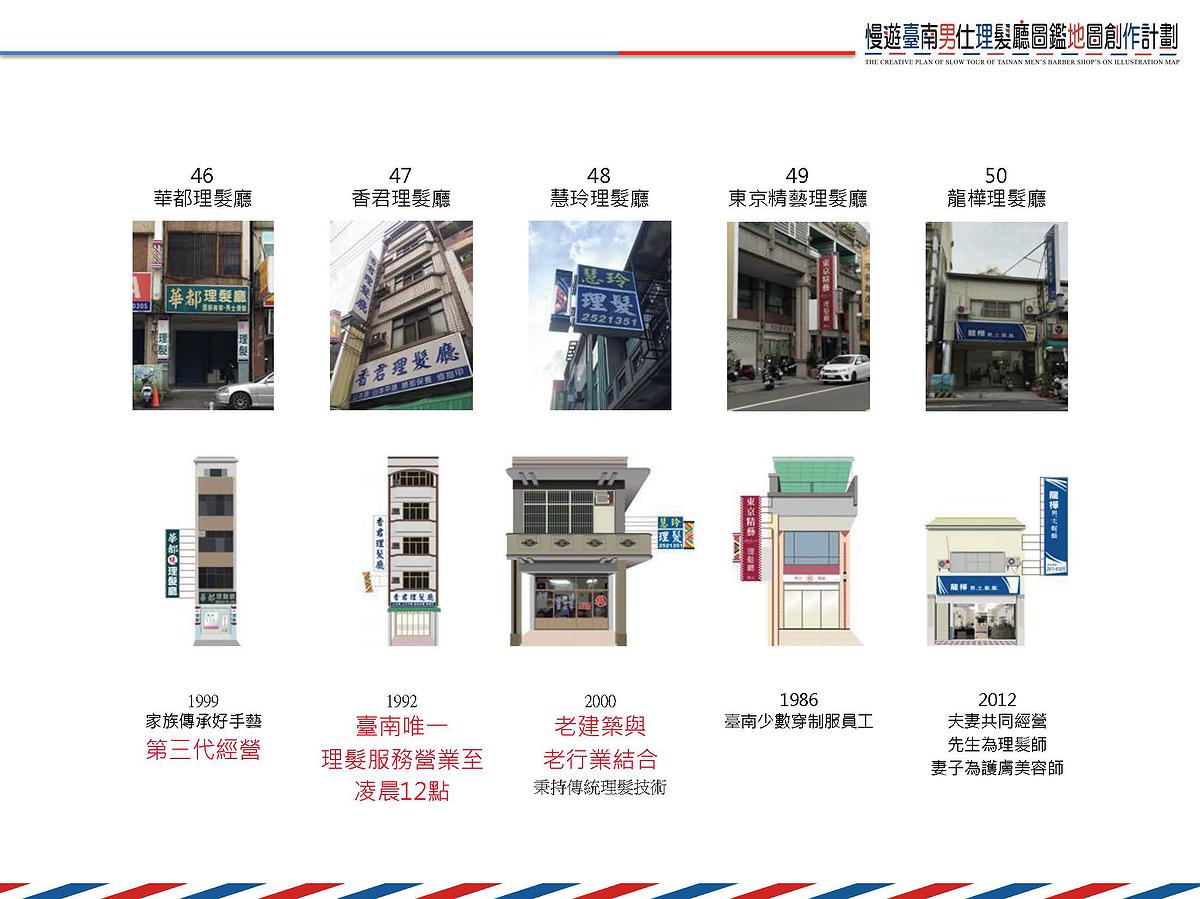
In recent years, 「barber shop」 this name has gradually explored. Through the arrangement of ‘Tainan Male Hairdressing Salon Illustration Map’s, the author records the most specific, the oldest, the most modern hairdressing salon. Hairdressing salons in Tainan are deeply influenced by Chinese, Japanese and European cultures. During the field trips, the author also experienced haircut in person in the hairdressing salon. The purpose of this research is to record more traditional industries so that they can be seen and valued, and operate sustainably.