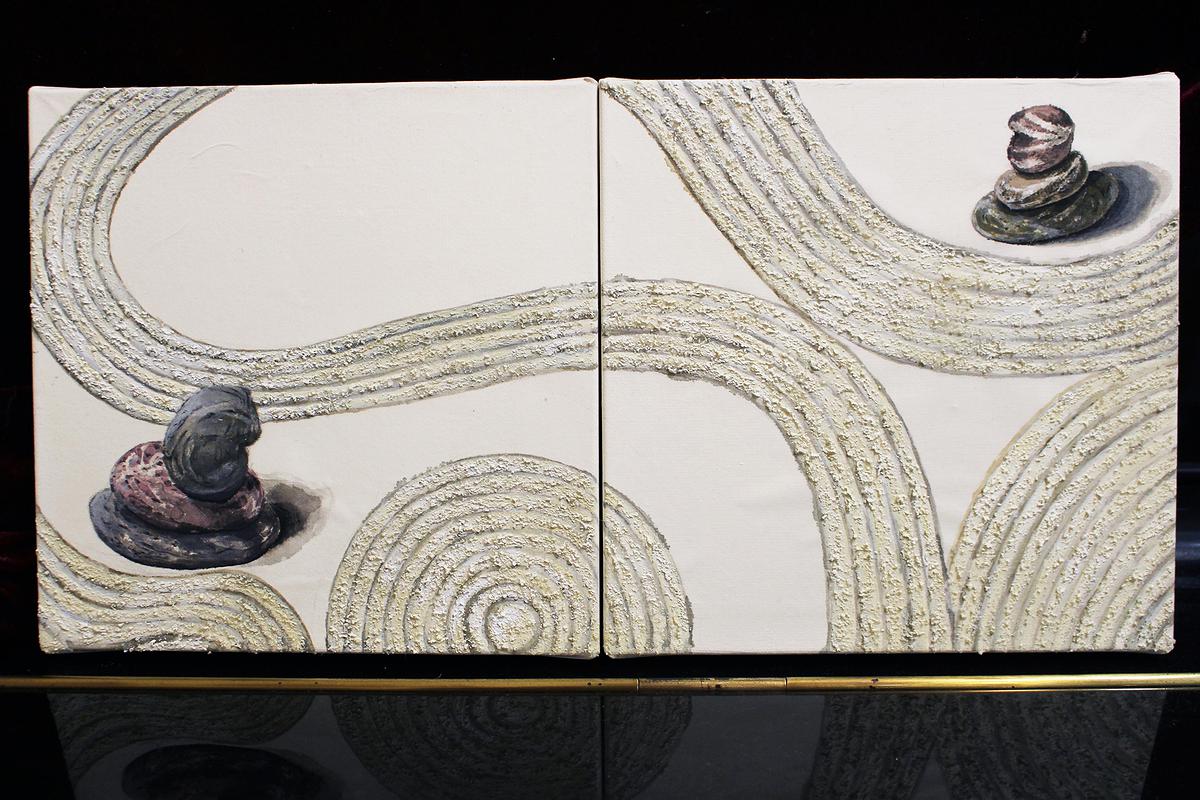
The paper begins the research and creation from the observation of the nature, between people and the environment, and the relation between one’s mind and the external environment. The author intends to sort the interconnectivity between the genuine perception inside and the external views from the artworks– which is the process of interaction of how the external environment connects with the mind and emotions. Moreover, the author attempts the adoption of “view borrowing” to express the external views while conveying another look inside the mind.
The paper adopts the “view borrowing” practice from Chinese garden landscaping to convey the observation angle from another psychological aspect. Instead of completely following the methods for creations, the author borrows views through naked eyes, photography and computer touch-up to present the images from “view finder” and presents the images as the container for expressing internal imagery. Such container creates a real and virtual situation but in fact carries another conversation between the mind and the external environment, people and things. It is a sincere mindset that wishes to tell the truth but also avoid confronting depiction.
The paper is divided into five chapters. The first chapter includes the research motive, research purpose, research method and aspiration for creation as well as the definition of scope. The second chapter includes the discussion and analysis of view borrowed from oriental garden, Chinese Zen, Confucianism, and withered mountain and water in Japanese gardens. The third chapter analyzes the intertextuality among artists, schools of ideas, and artists. For example, artists such as Chi-Kuan Chen, Guo-Song Liu, or surrealism artists can create another space embedded with imaginary. The psychological aspect is based on the psychology analysis from Freud, Erickson’s social development theory, and the mirror stage proposed by Lacan which integrates the extrinsic and intrinsic imagery with internal emotion expression, materials composed of images, and experiment. Chapter 4 lists give series from the creation, including: Inside/Outside the window, border line, withered mountain and water, view borrowing, and real world and virtual mirror reflection. The author conducts discourse of creation from the beginning to the end of the creation process and the emotional expression. Chapter 5 draws the “conclusion” and prepares the reflection and summary of the course of creations for this paper, with additional description of the future orientation of art development.