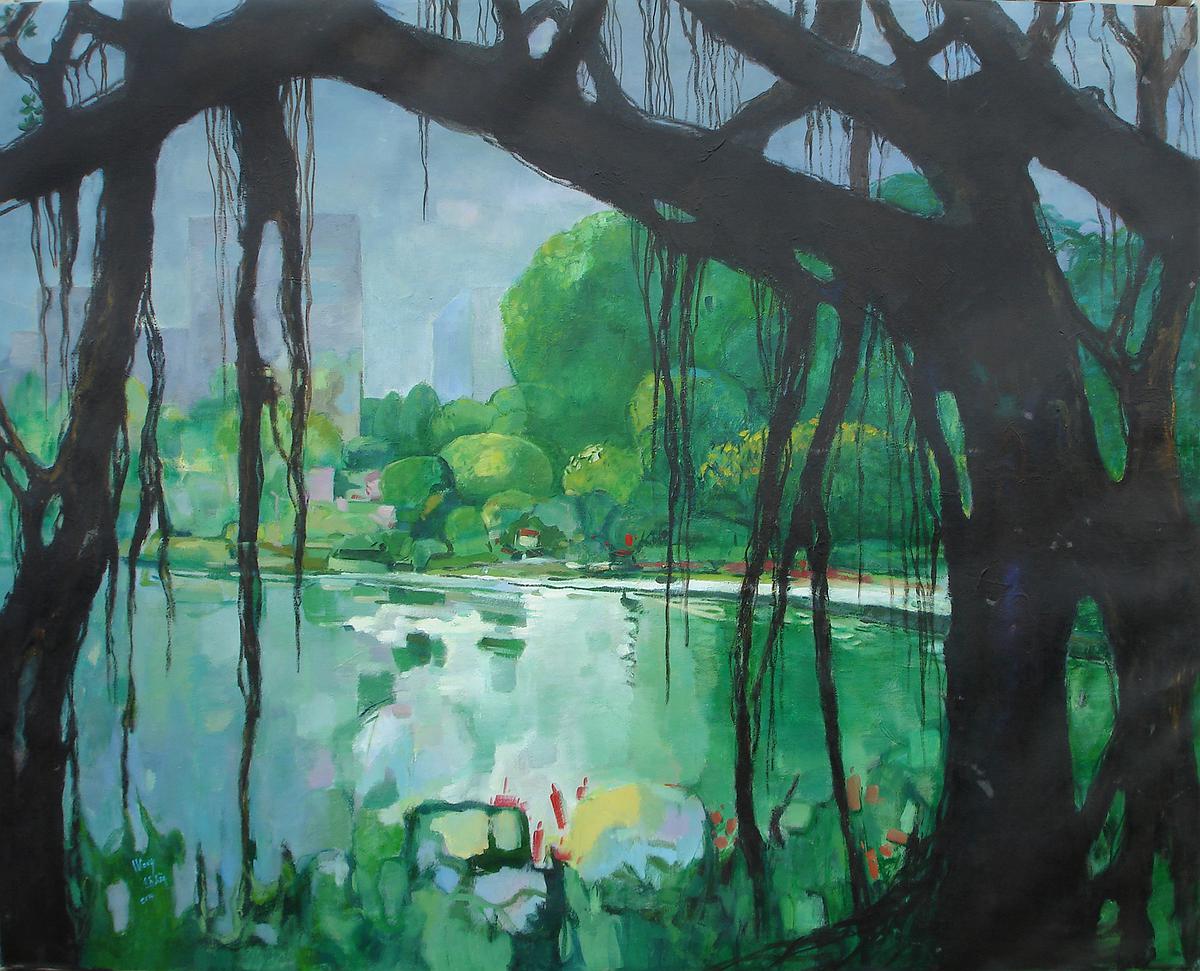
This thesis studies artist Che-Tsai Shen’s works in the following four aspects: 1. Shen’s family background and fine art education training; 2. Shen’s painting process and artistic journey; 3.Shen’s painting philosophy and an analysis of his artworks; 4. Shen’s influence on the fine art education in Tainan.
Che-Tsai Shen was influenced by School of Paris and was mentored by Jih-Chuen Liaw and Bor-Chuan Guo. The research indicates that Shen drew inspiration for his lively brushstrokes and colors in order to develop his unique painting style and sophisticated techniques not only from his teachers, but also from his personal collection of Japanese art related publications. His romantic painting style was not only inspired by Taiwan first generation artists’ painting philosophy and techniques, the various political environments and historic background such as the World War II and Japanese colonization and Chinese government’s ruling also enriched his lyric paintings. Tainan was a unique city with diverse architecture styles since it was shaped by its hundred years of history under Holland, Cheng -Gong Jeng, the Ching Dynasty, Japan and Chinese Government. Shen settled in beautiful southern Taiwan full of sunshine, palm trees and elegant flowers, and created many paintings in memory of Tainan’s famous temples, churches, magnificent landscape, and people’s daily life. Shen also dedicated himself to educate the younger generation of local artists and was recognized as a significant educator in Taiwan art history.
Che-Tsai Shen’s early works were bold and strong, with smooth and comfortable colors. In the middle of his career, the works became vibrant and bright, composed with fluent lines and full of rhythm. His later works reached high perfection both in compositions and colors. Fully inspired by his rich life experience, Shen always revealed romantic and elegant atmosphere in his paintings to reflect his firm inner belief in a peaceful life.
Key Words: Che-Tsai Shen, pictorial thinking, Taiwan art history,
Tainan Fine Art Research Society,