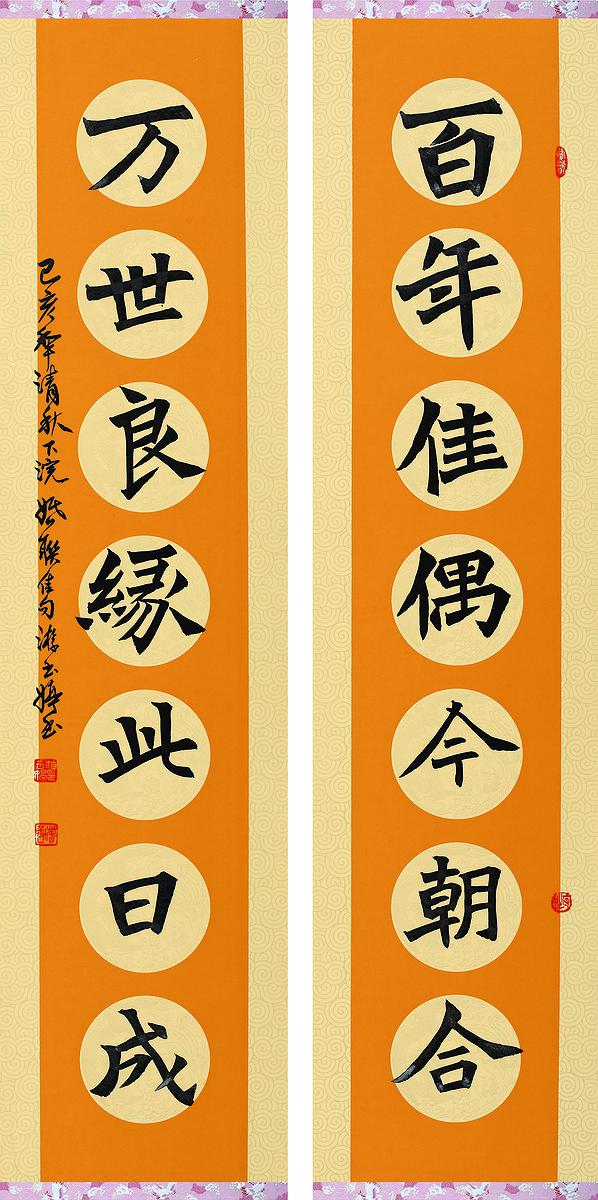
Kanazawa-sike (1924-2013), one of The Distinguished Four under the school of Yu You-ren, was the only Japanese disciple of Master Yu. Though a Japanese, he developed particular fondness for Chinese culture and traditional calligraphy. He excelled in all styles of Chinese calligraphy, and had been a renowned Japanese maestro in calligraphy, poetry of Han Dynasty as well as seal-carving. The main theme of this thesis focuses on the study of the calligraphy art of Kanazawa-sike. Kanazawa-sike was gifted with artistry and diligence; at the age of fifteen, he had determined to study calligraphy. At twenty-four, he studied under Japanese contemporary calligrapher Tesima-huuke. Then, at thirty-four, by the recommendation of his good friend Li Pu-tong, Yu You-ren took Kanazawa-sike as his Japanese pupil and conferred his treasured scroll of calligraphy, “Bouusoutou” on his atelier. For the rest of his life, Kanazawa-sike remained committing himself to the research and promotion of the standard cursive script of Yu You-ren, as well as an advocate for international benignity interactions of calligraphy.
In his twilight years, despite the affliction of health and the inability of his right hand, he displayed great perseverance under the encouragement and support from his family, turning the impediment in life into a promising opportunity. Instead of mourning after his loss, he poured into Master Yu’s style his own new conception and pioneered a new field of left-handed calligraphy. At 82, the adamant maestro turned the table of fate, gave the ebbing calligraphy art a new image and prospects, assertively returned to the international stage and became an acclaimed left-handed calligrapher.
Young Kanazawa-sike’s talents were broadly recognized, and he was awarded by Japanese Calligraphy Art Museum, New Japan Education Shodoin and Japan Exhibition of Calligraphy Art (later Japan Calligraphy Exhibition). He enjoyed considerable fame and was saluted and held in high regard by the Japanese Central Calligraphy Community. Despite all the celebrity, his honest and upright personality made him indifferent to fame and wealth. He resigned from the Japanese Central Calligraphy Community at the age of forty and dedicated all his attention afterwards to the research and promotion of Yu You-ren’s standard cursive script as well as passing the calligraphy art on to future generations. Not only did he consign himself to the teaching of calligraphy, but he also assisted Tomomatu-ryuudou in the revitalization of Takasakisyodoukai, resumed the publication of Ryuusyuuzasi as a chief administrator, and served as the third director of Takasakisyodoukai at the age of fifty for as long as 40 years.
Kanazawa-sike handed down marvelous masterpieces at every phrase of his life. In “Early works of the Calligraphy of Kanazawa-sike”, his works before the age of fifty, he displayed a feeling of freshness and elegance where he added warmth and smoothness into his strokes. Comprised and published at sixty, “A Collection of Kanazawa-sike’s Calligraphy Works” exhibits the calligrapher’s brushwork brimming with balanced tranquility, inner strength and concise resilience. The pieces done between sixty and eighty can be seen in another “A Collection of Kanazawa-sike’s Calligraphy Works”, where the maestro interprets his apprehension of calligraphy through sophisticated and eloquent strokes. To commemorate his groundbreaking works as a left-handed calligrapher, “A Selection of Kanazawa-sike’s Calligraphy Works” was published when he was eighty-eight, in which we sense purity, solemnness and sincerity. Kanazawa-sike’s calligraphy art, by this time, showed no concern about exquisiteness or bluntness. It emits a touch of freedom and nature coming straight from the heart; the more indelicate the more appealing and charming it is. His delight in calligraphy is evidently perceived in his refined ingenuity.