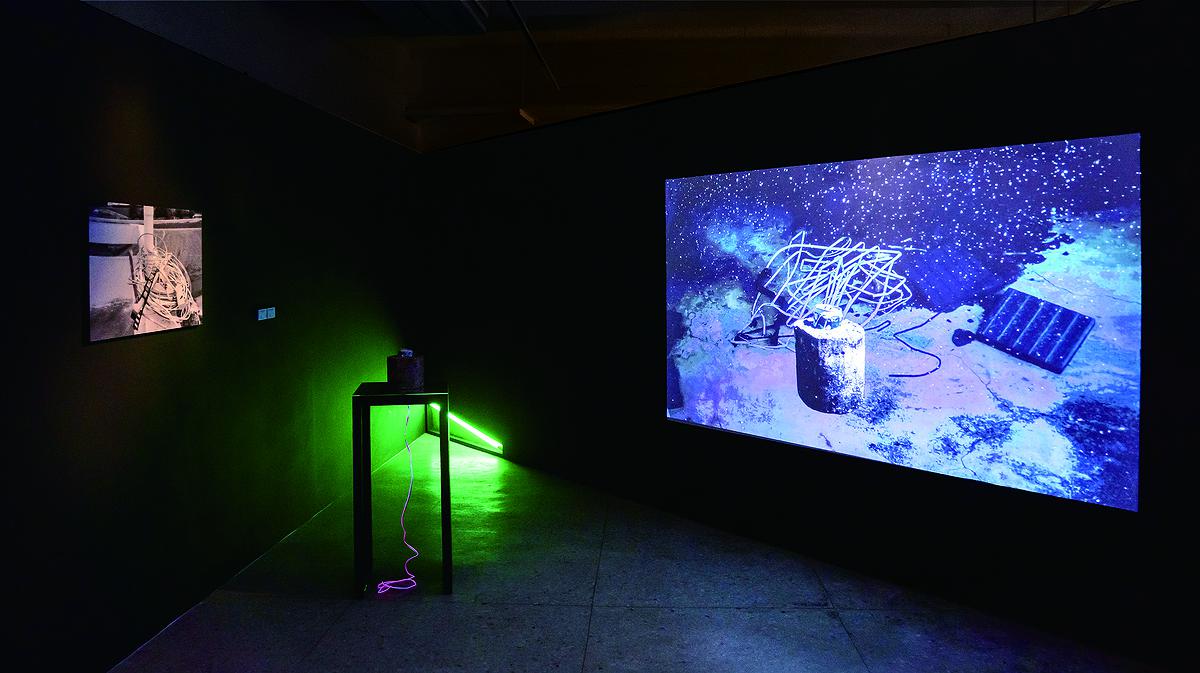
With the advancement of technology, our lives have been penetrated by the disintegration of time and the time-space interlaced illusion. I tried to create a channel for the extension of my personal imagination by deconstructing time and space. However, people switch multiple interfaces countless times a day. This situation makes our imagination and body consciousness often wander in a state of separation. Everything in the real world exists as if they were elements in a simulated scene. The individual is like a character implanted in it. The relation between self and reality is constantly struggling to deviate and return. Therefore, my spiritual imagination is achieved to a situation of wandering in temporary existence and confusion.
This report uses the diffusion of the sense of space and the variation of the shape to explain the creative process from here to the imagination of a different place. On the field where reality and imagination overlapped, I began to pay attention to the relationship between the scene and its relative position, transforming space into a place by moving my sights on islands, windows, roofs, and outer space. In Non-Place: An Introduction to Transcending Modernity Anthropology, Marc Auge once described: "Experience from afar allows us to learn to decentralize our views." I used perceptual connections to divorce the external scene from the original appearance in the material world. The deviated objects in the work symbolize the avatars in different time and space. This image leads to the "heterotopia" between the virtual and the real state. In this video game, the shape of the object uses different viewpoints to switch to different dimensions. I removed the subject; then I edited and returned it to a fictional place to build a series of loops of reality and illusion. On the other hand, the masses of destruction and vacancy present sensory illusions of memory and cognition brought about by different speeds. Because of the long-term exposure to the personalized media interface, the single linear history of the original materiality field has been transformed into a mirage of memory and cognition disorder. As a result, scenes that are mixed with memories, universals, cognition, and mental imagination are like kaleidoscopes of non-local characteristics.
The gaze starts from somewhere in the real sense organs to a place in the digital transport. Then the material is compressed into a medium with information and then goes to the virtual realm that is mixed with each other. After the object is transformed into an image, it brings out the world view that belongs to the object itself to create an object or scene-oriented time and space. In the end, by placing multiple messages to make space, objects, and images a carrier of fantasy, I tried to create a generation mechanism of imagination in a different place to go to a heterogeneous field with personal spiritual emotions.