Flourishing in the 21st century, the creativity is rooted on commercial interests and opportunism development. The so-called creative or innovative activity among the implementation of the design field is no longer limited to solve the problem of life or ask for survival, but it further meets the needs of the human psychological function. Not only the beauty reflected, but the emotional or cultural extension also has to be integrated within the creative activity. They are all retrieved from the life of itself, and they would be signifying meanings of one’s life in the hope to explore deeper creative contents.
First, the researcher explores the Zen spiritual connotation and its application, by using the Heart Sūtra , the Diamond Sūtra and the Platform Sutra of the Sixth Patriarch as the main basis of the text of creation. Next, the researcher deconstructs the texts in terms of the perspectives of the post-modernism and the semiotics, such as "the death of the author". With resonance to the researcher's own interpretation and her comprehension of meanings of life, she sets up the main themes and contents. As the result, the researcher employs Ferdinand de Saussure’s theory of ‘pairs of binary oppositions’ to conduct symbolic construction; she designs 6 series, and 16 items of small daily objects in the field of mixed- media design.
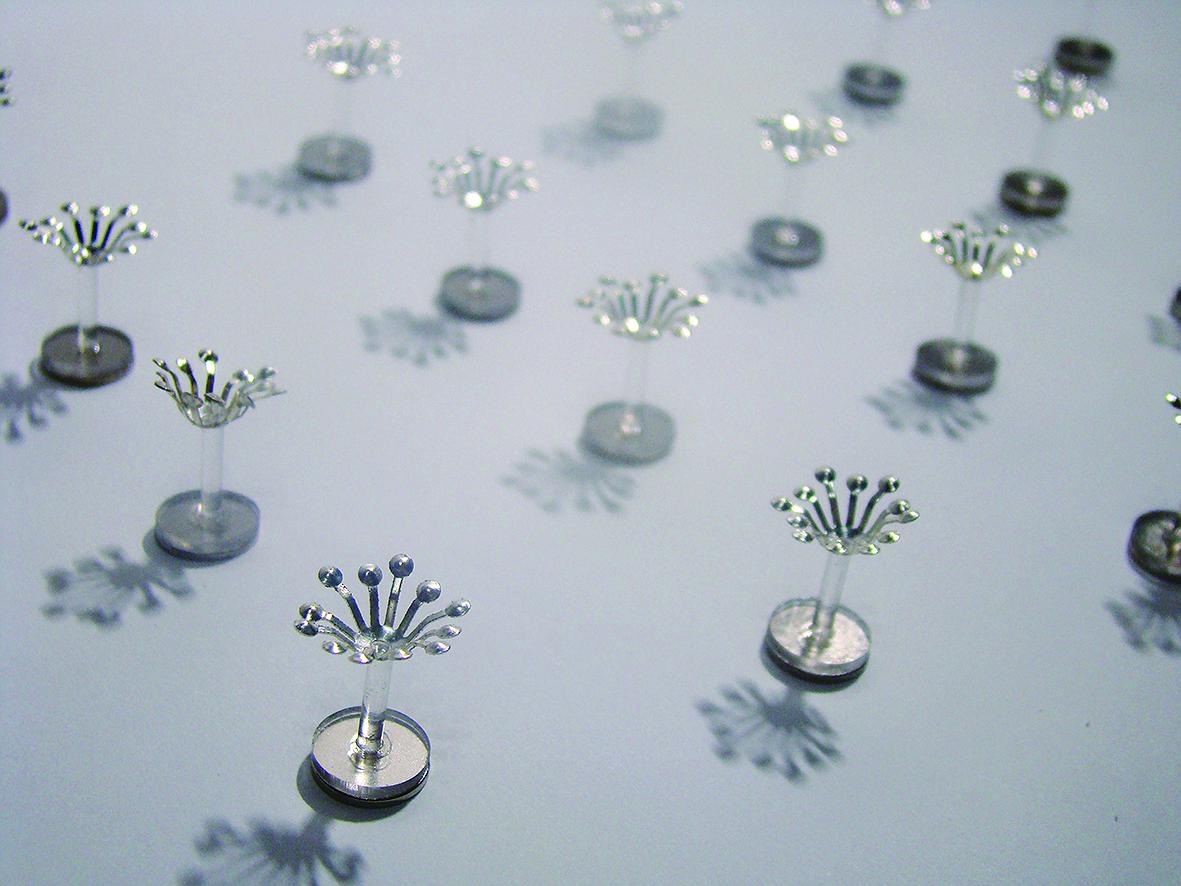
There are handmade soaps and a soap tray entitled as [Illusion];a duckweed vessel, a compartment tray, and a coaster, entitled as [Unlimited];the plant vessels entitled as [Confused]; the dandelion magnets entitled as [No appearance]; a wall clock entitled as [Present] ;the hooks series entitled as [No hinder]. The main visual performance is referred to Zen’s white and the natural style. Supplemented by the application of representative symbols of Zen, the creator here presents somehow concise and quiet status quo, and indulges into self-reflection to form her comprehension of Zen’s connotation as the context of life. Unlike the traditional expression in the past, she has developed design symbol objects that shape Zen spirit innovatively.
As the result, the research uses Roland Bart’s the ‘the theory of myths’ to deeply interpret the work’s connotation. The researcher analyzes the relationship between the connotation and the denotation. Therefore, the applications of the design of daily objects are not only to deliver Zen’s spirit that is an attitude to life, but also to narrow the ways for viewers to understand the Zen’s connotation in a hope to provides viewers another ways to understand life.